
Start with free official practice, then pay only for a specific gap: clearer instruction, useful feedback, a workable schedule, or accountability your child accepts. The best SAT prep is the smallest arrangement that helps the student solve fresh questions independently. A large package isn't automatically a better plan.
This guide shows you how to compare books, apps, courses, and tutors; run a useful trial lesson; calculate the full cost; and check whether the purchase earns its place. All budgets and family situations below are illustrative. They are not current market prices, testimonials, or promises of score gains.
SAT for Parents shares ownership with Aporo, an SAT learning product. This article uses a general evaluation framework and does not rank Aporo or any paid provider. It is not affiliated with College Board. Official practice resources are the starting point because families can inspect them before making a commercial decision.
Find the problem before shopping for the solution
Ask your child to show you one question they couldn't solve and one they answered correctly but couldn't explain. Watch where the difficulty begins. Is it understanding the wording, knowing the concept, selecting a method, executing the steps, or reviewing the explanation? A purchase should address that actual point of failure.
If the student knows the material but doesn't begin scheduled sessions, another question bank may not solve the problem. They might need a realistic routine, an agreed check-in, or a study group. If the student starts willingly but encounters unfamiliar algebra, a reminder system won't supply the missing instruction. Match the form of help to the need.
Separate the student's problem from the parent's discomfort. Paying for a course can feel like taking action, especially when other families are discussing tutors. But the useful question is what the child will do differently next Tuesday. If the answer is unclear, pause the purchase and gather a baseline. A clear assignment can be more valuable than immediate access to a large library.
Write a one-sentence buying brief. For example: “We need help translating word problems into equations, with feedback on the student's setup and one independent check afterward.” That brief is much easier to evaluate than “We need the best SAT tutor.” It also gives providers a fair chance to explain exactly how they would help.
Build the free official starting kit
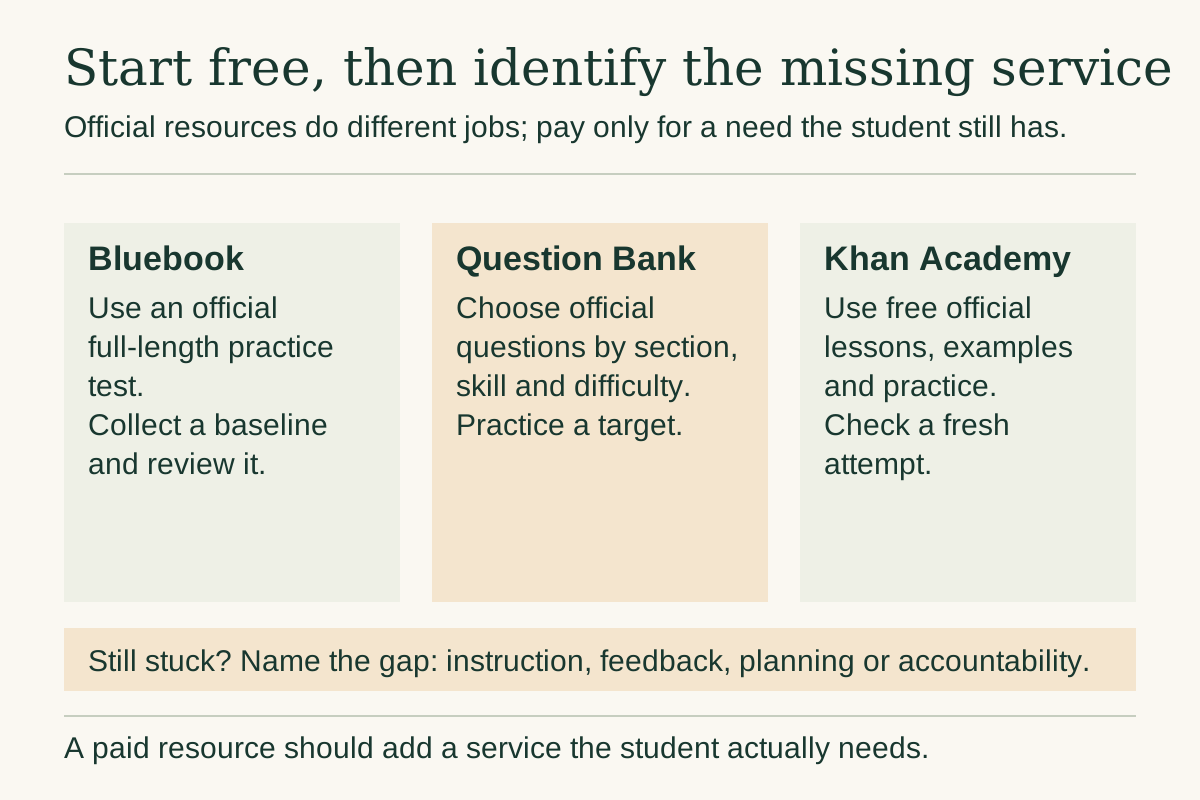
College Board provides scored full-length digital practice tests in Bluebook. Its short preview lets students explore the interface but doesn't provide a score or answer feedback. Use the official Bluebook practice page to distinguish the two. A family shouldn't need to buy a commercial diagnostic before seeing how the student handles official practice.
The Student Question Bank lets students choose official questions by assessment, section, domain, skill, and difficulty. That makes it useful for a narrow follow-up task after a baseline. Don't assume that browsing a large bank creates a study plan by itself. Someone still needs to choose a target, inspect mistakes, and check a fresh attempt.
Official SAT Prep on Khan Academy is free and developed in partnership with College Board. College Board's Khan Academy guide describes lessons, example videos, leveled practice, and quizzes. Start with the skill that the baseline actually exposed. Completing every available lesson in order may be unnecessary for a student with a specific gap and limited time.
These resources serve different jobs. Bluebook supplies the official full-test experience. The question bank provides focused official items. Khan Academy provides instruction and practice around skills. Use that division of work when evaluating a paid product. The provider needs to add something the student needs, rather than merely replace a free resource with a more attractive dashboard.
Run a short free-resource trial first
Choose one skill and two or three sessions. The student completes a small set, reviews an explanation, and solves fresh related questions. Keep a brief note of where help was needed. This trial isn't an experiment establishing the causal effect of free preparation. Its purpose is discovering whether the family can use the available resources and what remains difficult.
Suppose a student can learn a grammar rule from a short lesson and apply it independently, but struggles to choose what to study next. A planning conversation or modest amount of guidance may be enough. Another student may watch the same lesson repeatedly without understanding the sentence structure. That student needs a different explanation and responsive feedback, not more reminders to watch it.
Ask the child about the experience. Was the explanation understandable? Could they find the next task? Did the practice feel appropriately challenging? Was the device or account setup a barrier? A resource that is theoretically excellent but practically inaccessible to the student won't serve the family until the access problem is solved.
At the end, identify the smallest missing service. It could be a weekly check-in, a targeted lesson, a quieter place to work, or a course with a set meeting time. A free-resource trial can also show that no purchase is necessary yet. Put the next review date in the calendar and spend the money only when a need becomes clear.
Match each type of prep to the job it does well
Compare options by the work they enable, not by the number of features on the sales page. Most families need some combination of instruction, practice, feedback, and a schedule. A product can be strong in one area and weak in another. Your child doesn't need every form of help at the same intensity.
| Option | Useful when | Check before choosing |
|---|---|---|
| Official free resources | The student can follow a plan and learn from explanations | Who chooses the next task and reviews errors? |
| A current prep book | The student prefers a bounded sequence and written examples | Does it match the digital SAT and explain reasoning clearly? |
| An app or online platform | Convenient practice and immediate responses solve a real access problem | Are explanations accurate, feedback specific, and billing clear? |
| A live course | A fixed timetable and shared instruction fit the student | Is the pace suitable, and how are individual gaps handled? |
| One-to-one tutoring | The student needs diagnosis and responsive explanation | Does the tutor change their teaching based on the student's work? |
| A study group or peer support | Companionship and discussion improve participation | Is there a dependable way to resolve wrong explanations? |
Use the table to form a shortlist, not to purchase one of each. A student using a book and official tests may already have enough materials. Adding an app, course, and tutor can fragment the plan. If two resources provide the same practice with different labels, choose the one the student can use well.
For a parent, the strongest comparison question is simple: “What will my child do here that they are not doing now?” Ask for a concrete example. If the answer consists mostly of points, badges, lesson counts, or a broad promise of personalization, ask how those features change the student's next learning decision.
Choose a book by inspecting a lesson
A book can be a good fit when the student likes a defined path, wants to work away from notifications, or benefits from seeing several examples together. Inspect a chapter before buying if a sample is available. The explanation should connect the setup, method, answer, and check. A list of formulas without conditions isn't enough for a student who struggles to identify which relationship applies.
Check that the edition is intended for the current digital SAT. Older materials can still contain useful algebra or grammar teaching, but their test structure and timing guidance may belong to a previous version. College Board separately describes digital and paper practice tests, including the nonadaptive nature of the paper forms. A book's printed test shouldn't be treated as an identical replacement for adaptive Bluebook practice.
Read one explanation with your child. Ask the student to explain the key idea afterward, then try a fresh example. If the wording adds confusion, the book may not be the right teaching resource even if its table of contents looks comprehensive. A strong review from another family doesn't establish that the explanation works for this student.
Look for an answer process that discusses tempting errors. “The answer is C” contributes little when the student chose B for a plausible reason. Also inspect navigation: can the student find a lesson from a specific error, or must they read a long chapter first? Choose a book with a route from today's mistake to tomorrow's task.
Choose an app by testing the learning loop
During a trial or demonstration, ask your child to attempt a question before reading the explanation. Then inspect the feedback. Does it respond to the student's actual work, or display the same solution regardless of the misunderstanding? A standard explanation can still be useful, but it shouldn't be confused with diagnosis.
Test a wrong answer deliberately in the demonstration, using an ordinary misunderstanding. For a percentage problem, suppose the student applies the percentage to the wrong base. Does the system explain the base, or merely show arithmetic? For a reading question, does it identify unsupported wording in the selected choice? Feedback earns its place when it helps the student make a better decision on the next question.
Next, look for independent practice. A platform can guide the student successfully through a problem while providing so many hints that the apparent success says little about unaided performance. Ask whether the student eventually receives a fresh task without prompts and whether the report distinguishes assisted completion from independent work.
Finally, inspect the daily workflow. Can the student enter, find a suitable task, complete it, review it, and stop without getting lost? Notifications and streaks may encourage participation, but they don't establish understanding. Choose an app because it improves a real part of the routine. Don't buy it solely because the activity display looks busy.
Treat AI tutoring as a tool that needs inspection
If a product uses AI-generated explanations, ask how it handles mistakes, ambiguous questions, and unsupported claims. Request a sample lesson that includes student reasoning rather than only a polished final answer. The relevant question is whether the explanation is correct and useful for the student's actual misunderstanding.
Use a question with a solution you can verify, perhaps alongside an official explanation. Ask the system to explain why a tempting wrong choice fails. Then ask a follow-up that changes a condition. For example, changing a discount from 20% to 30% should change both the equation and the result. A system that confidently repeats the original answer hasn't handled the new question.
Don't let a correct final number hide faulty reasoning. In an original illustration, solving 2x + 5 = 17 gives x = 6. A tutoring explanation should preserve equality as it subtracts 5 and divides by 2. If the intermediate steps contradict that process, the student may learn a broken method even though the displayed answer happens to be right.
Ask what the student can do when an explanation seems wrong. Is there a reporting route, a way to consult a source, or access to human support? Also ask what is saved from conversations and uploaded work. These are evaluation questions, not claims that every AI product behaves alike. Apply the same standard of accuracy and understandable teaching that you would use for a person.
Choose a live course for its actual classroom conditions
A live course can help a student who benefits from a fixed appointment and a teacher-led sequence. Before enrolling, ask for the timetable, session length, homework expectation, class size, and policy for missed meetings. A course scheduled during the student's busiest school period may fail for practical reasons even if the instruction is strong.
Ask how the provider handles different starting points. A broad mixed-ability class may move too quickly for a student missing foundations and too slowly for another who needs advanced feedback. Find out whether there are placement options, office hours, or a route for individual questions. “All levels welcome” doesn't explain what teaching each student receives.
Request a sample lesson or observe a permitted session. Watch how much time students spend solving, explaining, and receiving feedback. A teacher can be entertaining and knowledgeable while leaving students mostly passive. The useful evidence is what happens when a student makes a mistake. Does the teacher inspect the reasoning and adjust, or continue the prepared presentation?
Clarify what happens between sessions. A weekly class with no review plan may leave the student uncertain about how to practice. A demanding homework schedule may compete with school. Ask for a sample week's assignments and estimate the real workload with your child. Choose the course that fits the student's learning need and available time, not the one with the longest syllabus.
Decide whether one-to-one tutoring is justified
Tutoring is most useful when a student needs someone to notice exactly where reasoning breaks and respond with a better explanation. It can also provide an agreed appointment and feedback the parent cannot comfortably provide. Specify which of those jobs you are buying. They require different amounts and types of tutor involvement.
Bring representative work to the first conversation. Include an incorrect answer, a correct answer with uncertain reasoning, and a question the student abandoned. Ask the tutor what they would investigate before planning lessons. A thoughtful response should distinguish possible causes rather than diagnose the student from a total score alone.
Don't treat the tutor's own score as a complete teaching credential. A high score may be relevant to content familiarity, but the trial lesson still needs to show clear explanation, diagnosis, patience, and appropriate challenge. The student should do meaningful thinking during the session. A tutor solving every problem rapidly is displaying their own skill, not necessarily developing the student's.
Start with a limited commitment when possible. One diagnostic meeting and a short sequence of targeted lessons can reveal whether the arrangement works. Ask what evidence would justify continuing and what would prompt a referral to a different form of help. A provider should be able to describe progress in terms more concrete than “confidence is growing.”
Use these questions in a tutor interview
Ask, “How would you find out why my child missed this question?” Listen for attention to the student's reasoning. A tutor who immediately supplies the answer may be skipping the diagnostic job. A useful follow-up is, “What would you ask the student before explaining?” The answer should reveal how the tutor distinguishes a concept gap from a reading or execution mistake.
Ask, “What would happen after today's lesson?” You want a plan for appropriate practice and a fresh independent check. A lesson can feel clear while the tutor is present and disappear when the student works alone. Find out how the tutor checks that transition. Homework should have a purpose and a review route, rather than simply being a large assignment.
Ask, “What do your progress reports actually show?” A report might include topics covered, independent performance, recurring errors, and next steps. Hours attended and questions attempted are participation measures. They can be useful, but they don't by themselves demonstrate learning. Ask whether the report distinguishes helped answers from unaided ones.
Ask, “What are the full terms?” Cover the rate, session length, preparation charges, cancellation rules, refunds, unused credits, recording, communication between sessions, and any required materials. Request the written version before paying. These questions help both sides agree on the service and reduce the chance that the family and tutor are imagining different arrangements.
Run a trial lesson with a clear observation plan
Choose a narrow target that the baseline supports. The student might need to translate a linear relationship, identify the base in a percentage problem, or distinguish a supported inference from an overstatement. Tell the tutor what you want to learn from the trial, while allowing them to investigate whether the apparent problem has a different cause.
At the beginning, have the student attempt an unfamiliar question independently. Watch what the tutor does with the result. A strong teaching move might be asking the student to label quantities, explain a choice, or compare two plausible approaches. The tutor should learn something from the attempt before deciding what explanation to give.
During instruction, the student should make decisions. They might predict the next step, explain why an operation is valid, or reject a wrong answer. This is different from agreeing with each step while the tutor talks. Avoid judging the lesson only by whether everyone feels comfortable. Some useful thinking involves uncertainty, provided the student receives understandable support.
End with a fresh question and fewer prompts. Then, on a later day, ask the student to attempt another related task. Don't demand flawless mastery after one lesson. Instead, inspect whether the student can use the central idea more independently and knows what still needs work. That gives the family a better basis for continuing than the warmth of the sales conversation.

Use a simple trial-lesson rubric
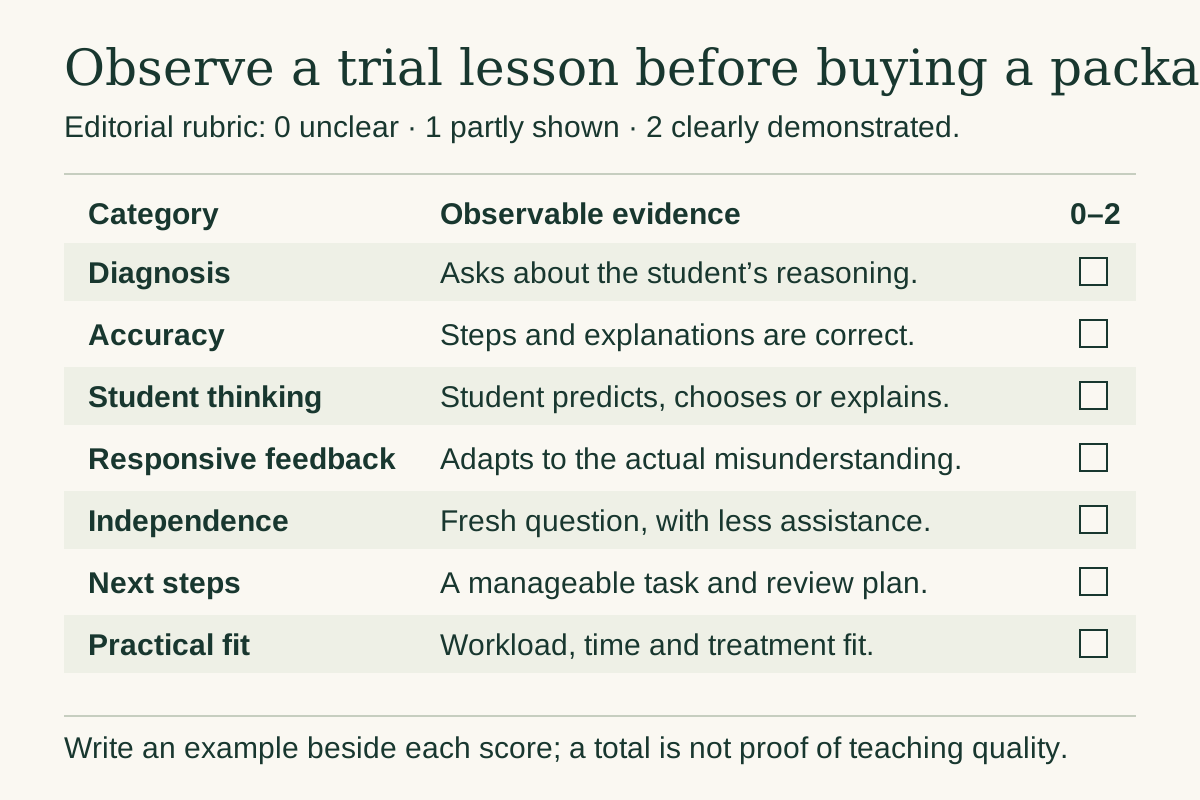
Score each category from zero to two: zero means absent or unclear, one means partly demonstrated, and two means clearly demonstrated. This is an editorial comparison tool, not a validated measure of teaching quality. Use notes beside the numbers. A total can organize observations, but it shouldn't erase a serious concern about accuracy or how the student is treated.
| Category | What a clear demonstration looks like |
|---|---|
| Diagnosis | The teacher identifies a specific difficulty using the student's work |
| Accuracy | The explanation and worked steps are correct |
| Student thinking | The student explains or chooses meaningful steps |
| Feedback | The teacher addresses the actual misunderstanding |
| Independence | A fresh check uses less help |
| Next steps | The student leaves with a manageable task and review plan |
| Practical fit | The time, technology, and communication work for the family |
After the lesson, ask your child which part helped and which remained confusing. Don't replace their answer with your own impression of the teacher's personality. A tutor may communicate well with the parent but poorly with the student. Conversely, a quiet session can contain substantial learning if the student is doing careful independent work.
If one category is weak, ask whether it can be repaired. Perhaps the homework load needs reducing or the teacher needs examples of the student's school schedule. If accuracy or respect is repeatedly poor, seek another option. You don't need to purchase a long package to give an unsuitable arrangement more time.
Calculate the full cost before comparing prices
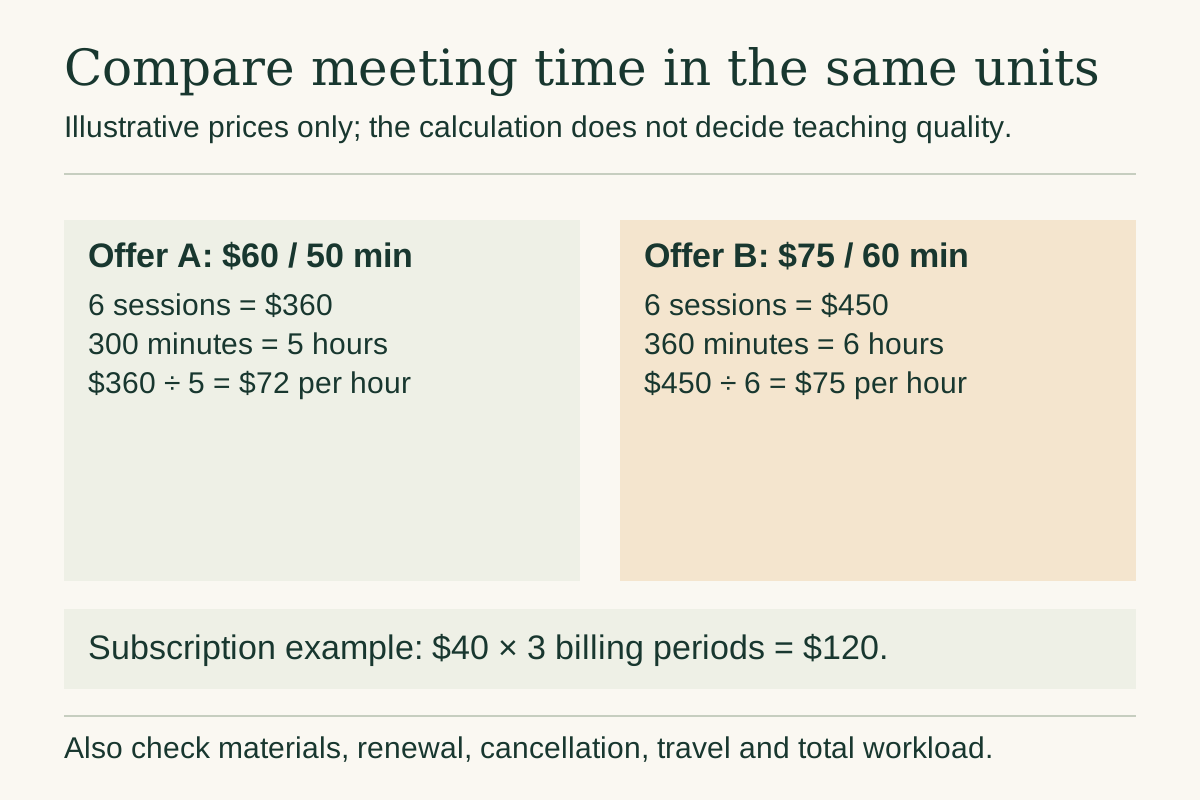
Convert every offer into the same units. Record the payment, number of sessions, actual session duration, required materials, subscription period, and any setup fee. A lower advertised session price can be misleading if sessions are shorter or require a larger commitment. Compare the service the student will actually receive.
Consider an illustrative tutor charging $60 for a fifty-minute session. Six sessions cost $360 and provide 300 minutes, or five hours, of meeting time. A different illustrative offer charges $75 for sixty minutes. Six sessions cost $450 and provide six hours. The first is cheaper overall; its meeting-time rate is $72 per hour, while the second is $75. This arithmetic doesn't decide which teacher is better, but it prevents comparing unlike units.
For a subscription, calculate the expected total across the preparation period. A hypothetical $40 monthly plan used for three billing periods costs $120 before any additional charges. Check whether cancellation stops the next renewal, ends access immediately, or follows another written rule. Don't assume a three-month study plan and three billing periods begin and end on the same dates.
Include nonfinancial costs: travel, setup, parent administration, missed activities, and time spent moving between resources. A cheaper course across town can consume an entire evening. A more expensive targeted lesson might require less total time. Use the full picture, then choose within a budget the family can comfortably sustain. None of these examples represents a current provider's offer.
Read guarantees as terms, not forecasts
A score guarantee is a commercial promise with conditions. Ask what result triggers it, what baseline is accepted, how attendance and homework are verified, which test date applies, and what remedy is offered. A refund, more lessons, and credit for future services are different outcomes. Read the written terms before treating the word “guarantee” as protection.
Ask what the family must pay or do to qualify. A promise may require completing a large amount of work, submitting reports by a deadline, or taking tests under specified conditions. Those requirements may be reasonable, but the student must be able to meet them. Don't buy a package assuming the guarantee will compensate for a schedule that already looks unrealistic.
Be careful with average gains in advertising. Ask who was included, how missing results were handled, whether the tests were comparable, and whether students had already seen the questions. A selected group of completers can differ from everyone who enrolled. A before-and-after difference alone doesn't establish that the provider caused the change.
You don't need to conduct a research audit before every modest purchase. You do need to avoid translating a marketing number into a prediction for your child. Choose based on the actual service, trial evidence, practical fit, and written terms. The provider should be useful even if the advertised average doesn't describe this student's experience.
Inspect privacy and account arrangements
Ask what the service collects: account details, payment information, responses, uploaded reports, messages, recordings, or voice. Then ask why each category is needed, who can see it, how long it is retained, and how deletion works. These are questions to check in the provider's current policy and contract, not assumptions that every service follows one practice.
Avoid uploading a complete score report when a few skill observations would do. A tutor might only need to know that the student struggles with inference questions and unit conversions. Share the minimum information necessary for the agreed service. If the provider requests sensitive documents, ask whether a redacted version or a direct conversation can serve the same purpose.
Clarify who owns and manages each account. The student should understand the learning account and what activity is visible to the parent. Don't use shared passwords as the default route for monitoring. Ask whether the service offers an appropriate parent view, what it shows, and whether the student knows about it. A workable arrangement needs clear expectations on both sides.
If lessons are recorded, find out whether recording is optional, where files are stored, who receives them, and when they disappear. For an AI service, ask whether conversations or uploaded work are used for model improvement and what choices the family has. If the answer remains unclear, choose a lower-data arrangement until the provider gives a usable explanation.
Keep accountability separate from surveillance
A parent may want reassurance that the purchase is being used. Agree on a small set of useful signals: scheduled sessions completed, a current target skill, one fresh independent example, and the next task. That can be enough for a weekly conversation. Monitoring every click can create conflict without showing whether the student understands the work.
Ask the student what kind of reminder helps. A calendar alert, one text, or a fixed study partner may be welcome. Repeated questioning throughout the evening can make preparation feel like a continuous inspection. If the family is paying for accountability, ask the provider to define how it works and how the student participates in the agreement.
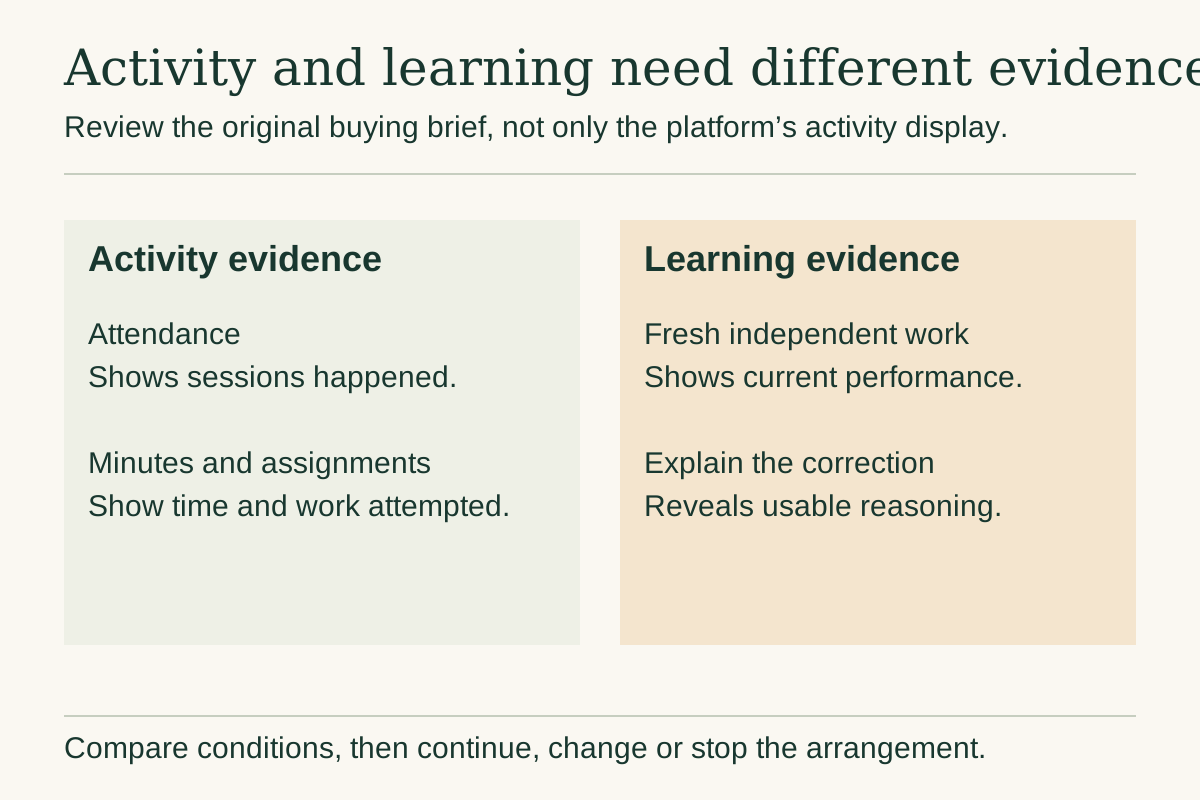
Don't confuse compliance with learning. A student can keep a streak while choosing easy questions or clicking through explanations. Another student can make substantial progress in a smaller number of demanding sessions. Activity data helps you ask questions, but it doesn't settle the question of understanding. Request examples of what the student can now do independently.
If the student consistently avoids the resource, investigate before renewing. The workload may be too high, the teaching unclear, the target irrelevant, or the family agreement unworkable. A provider might repair the issue, or a simpler arrangement might fit better. Continuing a subscription because cancellation feels like admitting failure only extends the cost.
Compare progress without fooling yourself
Save the baseline conditions and use fresh official practice when a meaningful checkpoint is needed. Record whether a test is repeated and whether help, timing, or interruptions changed. An improved result can be encouraging, but the comparison becomes harder to interpret when several conditions change at once.
Inspect a few target skills between full tests. If the purchase was meant to help with equation setup, can the student now translate a new situation without prompts? If it was meant to improve reading evidence, can they identify which words support a conclusion? These checks connect the paid service to the actual buying brief.
Keep participation and learning in separate columns. Attendance, assignments completed, and time used show whether the arrangement happened. Fresh correct solutions and explanations show something about performance. Confidence and satisfaction add another useful perspective. None should silently stand in for all the others. A friendly tutor can be a good relationship while the learning plan still needs adjustment.
At the review date, decide to continue, modify, or stop. Continue if the service is producing useful work and the cost remains acceptable. Modify if the need is clearer and the provider can respond. Stop if the service remains unused, inaccurate, or poorly matched. Our study-plan guide explains how to make the next routine smaller and more specific.
Work through three hypothetical buying decisions
First, consider Lina, who completes schoolwork independently and wants a defined SAT routine. Her baseline reveals a few grammar gaps, but she can learn a rule from a written explanation and use it on a new question. The smallest first choice is official resources plus a weekly planning check. A large tutoring package would need to add a service she actually lacks.
Next, consider Theo, who repeatedly sets up word problems incorrectly even after reading explanations. During a trial lesson, a tutor notices that he assigns variables inconsistently and teaches him to label quantities before writing the equation. A fresh check shows a clearer setup, though he still needs practice. A short targeted tutoring sequence could be justified, with a later review of independence rather than an open-ended commitment.
Finally, consider Amina, who understands many questions but rarely begins practice alone. She dislikes an app's notifications and finds a long self-paced course difficult to navigate. A fixed small-group session might provide a better appointment, provided the teaching level and schedule fit. Buying a second self-paced library would leave the main obstacle unchanged.
These examples don't predict outcomes or establish that one format is superior for everyone. They show how the buying brief changes the choice. Each family can begin with a limited arrangement, inspect actual work, and revise. The decision should follow the student's current need, even if another family chose a more expensive or more fashionable option.
Avoid paying twice for the same job
List every resource currently in use and write one job beside each. Perhaps Bluebook supplies checkpoints, Khan Academy supplies instruction, a book supplies organized review, and a tutor diagnoses persistent gaps. If two products both claim to be the main daily plan, decide which one leads. Conflicting assignments can make the student spend more time managing preparation than doing it.
Look at unused purchases before adding another. A half-finished course may be unsuitable, but it may also contain the exact lesson the student needs. Inspect the reason it stopped working. If the explanation is too advanced, use another teacher for that gap. If the problem is navigation, a simple assignment may recover value without another subscription.
Don't require the student to finish a resource just because it was purchased. That is a separate mistake from buying too much. The money is already spent; the next decision concerns how to use the student's remaining time. Keep the parts that serve the current target and set aside the rest. Completion percentages don't have to control the preparation plan.
Before renewing, ask what would disappear if the subscription ended. If the student would lose a useful feedback loop, continued access may be worthwhile. If nothing in the weekly routine depends on it, cancel according to the written terms and keep the confirmation. Revisit the need later if circumstances change.
What if the family has very little money for prep?
Begin with the official free kit and ask the school counselor about available support. College Board's student preparation resources also identify free peer tutoring through Schoolhouse.world. Check the current program's availability and suitability directly rather than assuming a particular group or timetable is guaranteed.
Prioritize access before buying materials. A suitable device, dependable study time, transport to testing, and help understanding official requirements may matter more than another course. Ask what the student can use through school or a public library. If internet access is inconsistent, choose a plan that acknowledges that constraint instead of assigning online work that cannot reliably happen.
Use help selectively. A teacher might explain one recurring algebra gap, a peer might provide a scheduled practice appointment, and official explanations might cover the rest. Agree how errors will be checked so that a study group doesn't reinforce a misunderstanding. Free support can still need organization, but organization doesn't have to become a paid service.
Avoid treating a small budget as evidence that the student is less serious. Preparation quality depends on what the student learns and can apply, not on the invoice. A family can make a careful plan with free materials, review the evidence, and decide later whether a specific paid lesson would earn its cost. The parent SAT guide provides the wider starting context.
What if the test is soon?
A short timeline increases the value of diagnosis and reduces the value of a large unused syllabus. Ask what can realistically change before the administration. A limited concept repair, interface practice, or a better plan for handling difficult questions may be feasible. Promising to master every weakness in a few days is not a sound basis for a purchase.
Bring deadlines into the decision. Confirm the actual test date, score availability, and college or scholarship requirements through the relevant official sources. A provider's course calendar doesn't determine when a college will accept scores. Our guide to when your child should take the SAT shows how to separate these dates.
For a last-minute tutor, ask for a precise service: review the baseline, choose one or two priorities, teach them, and leave a manageable final plan. Avoid spending the entire session discussing a broad sales roadmap. If the main issue is registration or device readiness, solve that practical problem first using the registration checklist.
Preserve a stopping point. A student shouldn't enter test day exhausted from trying to extract every possible hour from an expensive emergency package. The family may decide that a later optional attempt is more sensible, or that the current score serves the application plan. Evaluate that choice using real requirements and the student's circumstances, not the provider's urgency.
Make the purchase decision on one page
Write the student's need at the top, followed by the selected service, full cost, weekly workload, and first review date. Add the evidence you expect to see: a clearer setup, a fresh correct explanation, independent completion, or a routine that actually happens. Keep the expectation specific enough that both the student and provider understand it.
Below that, record the written cancellation and renewal terms and the person responsible for handling them. Put any deadline in the family calendar. Save the agreement and payment confirmation somewhere you can find them. This is ordinary purchase administration; it shouldn't become the student's daily burden or a reason to collect unnecessary learning data.
Ask your child to explain the first week's plan back to you. They should know where to begin, what to do when stuck, and how the work will be reviewed. If those answers are unclear, clarify them before paying for more access. A service becomes useful when it turns into a manageable action.
Choose the smallest commitment that answers the buying brief, then judge it by the student's work. Start with one target, one appropriate source of help, and one independent check. Set the review date now so the next decision follows evidence rather than renewal momentum.