
Start with one official practice test, choose two skills to improve, and build a weekly routine your child can repeat without giving up schoolwork or sleep. Your most useful job is protecting that routine and helping the student interpret mistakes. You don't need to become the household SAT teacher.
This guide gives you an eight-week plan, a twelve-week alternative, original worked examples, and a way to decide whether the plan needs changing. The schedules are editorial suggestions, not College Board requirements or promises of a particular score increase. The hypothetical students illustrate decisions; they aren't testimonials.
Begin with the student's reason for taking the SAT
Before discussing hours, ask what the test is supposed to accomplish. A student considering colleges with a testing requirement has a different problem from a student exploring whether a score might strengthen an optional submission. Scholarship requirements can add a separate deadline or target. Write the actual decision down. A target without a destination can turn preparation into an endless attempt to make a number feel reassuring.
Make a short list of colleges or programs worth investigating, then visit their own admissions and scholarship pages. Record the entering class, policy, deadline, and reporting method. Don't import another family's target or assume that last year's rule still applies. If your child doesn't yet have a college list, a first practice result can be useful information without becoming a commitment to months of intensive study.
Next, ask the student to state a personal goal in ordinary language. It might be understanding the Math questions well enough to finish calmly, earning a score that creates an additional application option, or improving a weaker section. Keep that process goal beside any numerical target. A score is an outcome; the family needs actions it can carry out this week.
Set a first review date before buying anything. Two or three weeks is a reasonable editorial starting point for reviewing whether the routine is workable. That meeting should answer whether sessions happened, which errors changed, and what support is missing. It isn't an occasion to demand a large immediate score increase. For help choosing the wider calendar, use our guide to when your child should take the SAT.
Make the first practice test useful
Use a full-length official digital practice test in Bluebook as the baseline. College Board distinguishes the short, unscored test preview from scored full-length practice. Bluebook practice results can then be reviewed in My Practice. That distinction matters because clicking through a preview doesn't produce a baseline score. See the official Bluebook practice overview.
Choose an ordinary day with enough uninterrupted time. Ask the student to use the device and working conditions they expect to use for the test as closely as practical. Record interruptions, extra breaks, unfamiliar tools, and any help received. These notes aren't excuses. They tell you what the result actually measures. A practice session completed beside a noisy family gathering answers a different question from one taken under steady conditions.
Don't coach from the next chair. A baseline with hints can hide exactly the difficulties the plan needs to address. Agree that questions can be discussed afterward, and make it easy for the student to flag uncertain answers. A correct guess deserves review too. When a student marks an item correct but can't explain the reasoning, the family hasn't yet found a reliable skill.
After the test, give the student a break before opening the report. Then inspect section performance and a small sample of questions together. College Board's My Practice guide explains how to inspect answers and explanations and access tailored practice. Use those features to locate work to do. Don't spend the first review comparing the result with friends or calculating hypothetical admission chances.
Build a baseline that includes more than a score
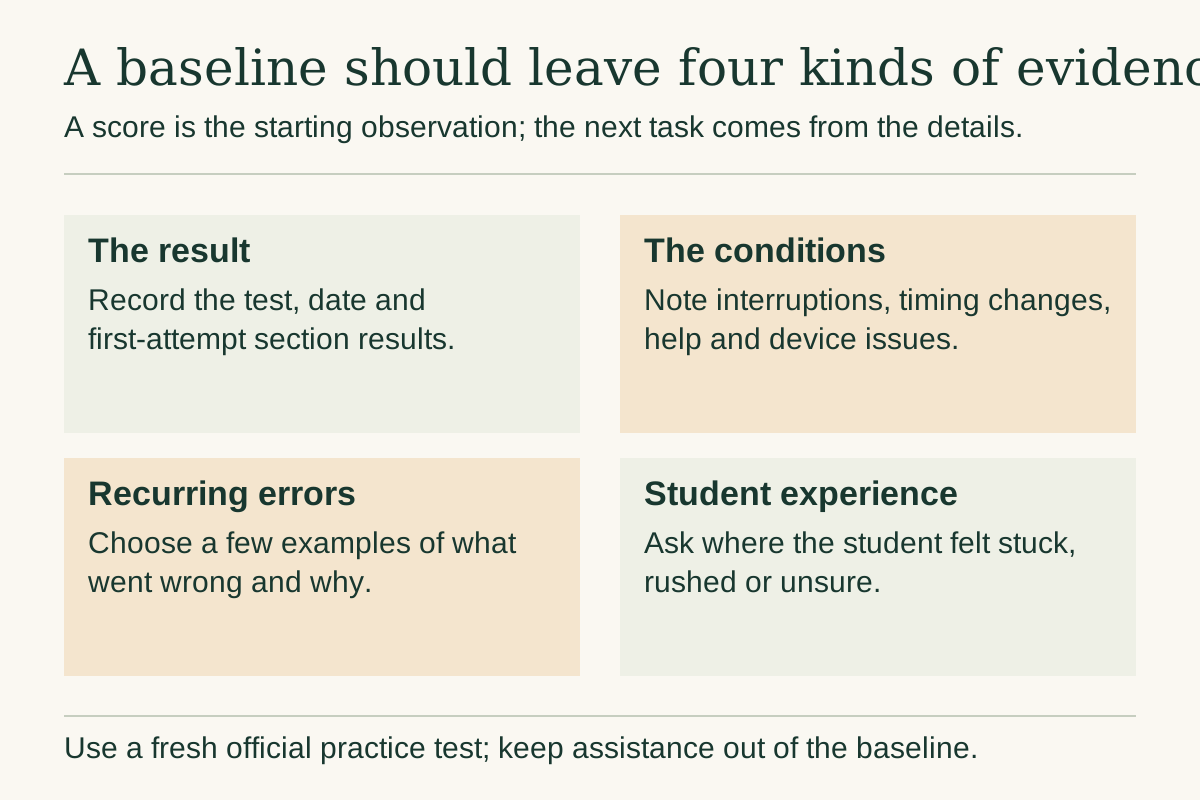
A useful baseline has four parts: the result, the conditions, the recurring errors, and the student's experience of the session. Put them on one page. You want enough detail to choose practice, not a complicated tracking system. A notebook, simple document, or sheet of paper can do the job.
For conditions, note the practice test identifier, date, whether it was a first attempt, and anything that changed normal timing. For error patterns, choose a few categories rather than copying every question. For experience, ask where the student felt stuck or rushed. A student who ran out of time after repeatedly rereading one passage needs a different intervention from one who finished quickly but misread task instructions.
Consider a hypothetical student, Elena. Her review reveals that she can explain linear equations but loses track of units in word problems. She also selects reading answers that sound reasonable but contain an unsupported claim. Her first priorities could be translating quantities carefully and checking answer choices against the passage. Buying an advanced Math course because Math feels less comfortable would miss the more precise problem.
Another student, Marcus, repeatedly encounters concepts he hasn't learned in school. He needs instruction before speed practice. The same incorrect answer can come from a missing concept, a reading mistake, or a rushed calculation. Ask what happened before assigning a fix. Your first plan should fit the explanation supported by the student's work.
Pick two priorities and keep the rest in maintenance
Choose one substantial priority in Math and one in Reading and Writing, unless the baseline strongly supports concentrating elsewhere. Two priorities are usually easier to remember and review than a list of ten weaknesses. This is a workload choice, not a claim that every student learns at the same pace.
College Board organizes SAT Math into Algebra, Advanced Math, Problem-Solving and Data Analysis, and Geometry and Trigonometry. Reading and Writing includes Information and Ideas, Craft and Structure, Expression of Ideas, and Standard English Conventions. The official Math overview and Reading and Writing overview give the domain map. Translate those broad labels into an observable task before choosing exercises.
“Improve Algebra” is too wide for a Tuesday evening. “Translate a fixed fee plus a per-item charge into an equation” is workable. “Get better at reading” is similarly vague. “Reject answer choices that introduce a claim the passage doesn't support” gives the student something to practice and explain. A narrow target also makes it easier to tell whether a tutor or app is helping.
Keep a small amount of mixed work so stronger skills don't disappear from view. If every exercise announces the exact method to use, the student can succeed by following the section heading. Mixed practice asks the additional question: can the student recognize which method fits? Don't increase difficulty automatically after one good set. First check whether the student can solve a fresh problem independently.
Choose a weekly routine before choosing a total number of hours
Start with time the family can protect. Three focused sessions and one short review meeting can be more workable than a daily plan that collapses by Thursday. A sample week might contain two thirty-five-minute skill sessions, one forty-five-minute mixed session, and a ten-minute planning conversation. Those times are suggestions to adapt, not a minimum needed for success.
Each skill session needs a small opening task, a main activity, and a check. The opening task retrieves something studied earlier. The main activity addresses the current target. The check uses a fresh question without help. This structure prevents a session from becoming forty minutes of watching someone else solve problems.
Put sessions in the student's calendar alongside school deadlines, work, sport, religious commitments, and family duties. Count travel and recovery time. If a practice slot exists only when nothing else happens, it isn't a protected slot. Give the student a choice between two realistic times and agree how a missed session will move.
Don't repay a missed thirty-minute session with a three-hour punishment block. That teaches the family to associate preparation with debt. Move the essential task, reduce the optional work, and resume the plan. If sessions are repeatedly missed, inspect the schedule before questioning the student's character. A smaller plan that happens provides better evidence than an ambitious one that remains theoretical.
Use a twelve-week plan when there is room to learn steadily
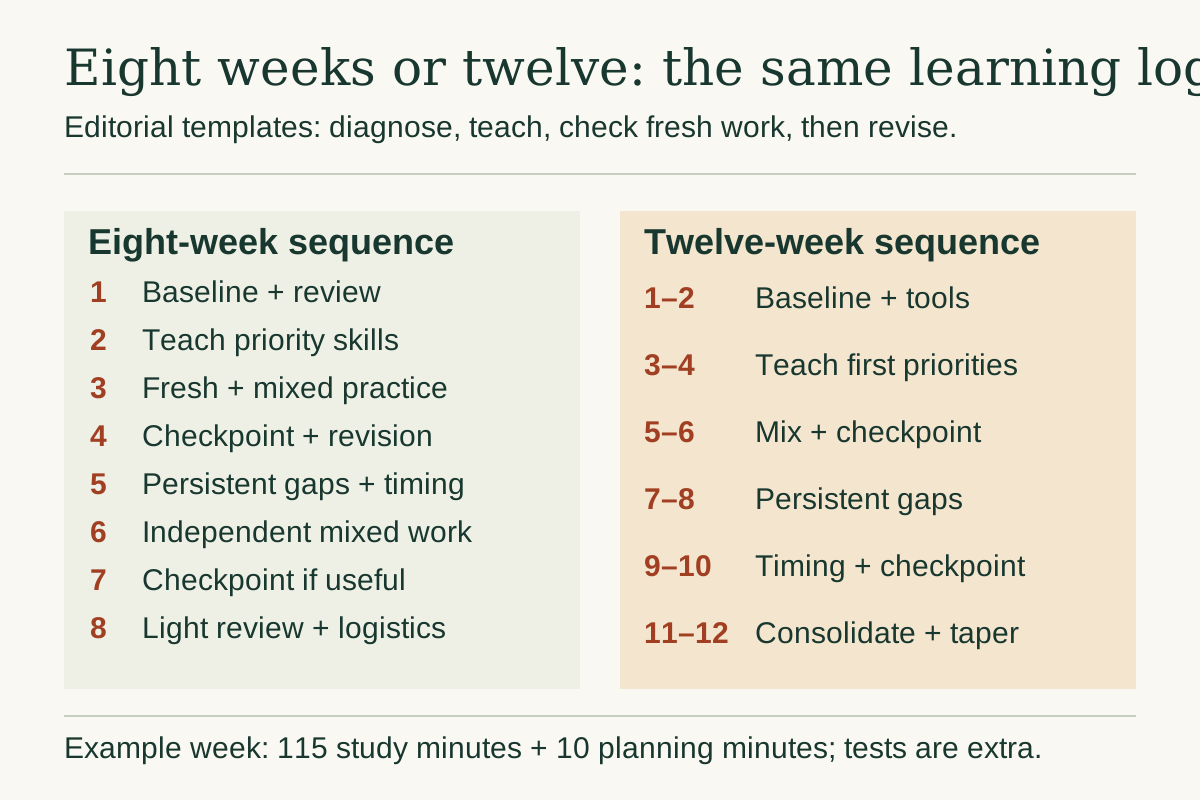
The twelve-week version below separates orientation, skill work, mixed practice, and final preparation. It assumes the student can sustain several modest sessions most weeks. A school examination week can become a maintenance week. The calendar should bend around important academic work rather than turn every conflict into an emergency.
| Weeks | Main job | Evidence to keep |
|---|---|---|
| 1–2 | Take the baseline, review errors, learn practice tools, select two priorities | Baseline conditions and three representative errors |
| 3–4 | Teach and practice the first priority skills | Fresh independent solutions and short explanations |
| 5–6 | Mix the first skills with related tasks and check a second practice test | Comparison of errors, timing, and conditions |
| 7–8 | Address the most persistent gaps and maintain stronger areas | Examples showing whether the same mistake returns |
| 9–10 | Practice decisions under realistic timing and complete another checkpoint | Completion patterns and unresolved skill needs |
| 11–12 | Consolidate familiar methods, rehearse logistics, taper the workload | Final checklist and a small review packet |
During the first two weeks, resist filling every available evening. Learning how to review an explanation is part of preparation. The student should be able to say why the correct answer works, why the tempting wrong answer fails, and what they will notice next time. That is a stronger foundation than racing through a large question count.
In the middle weeks, let the evidence choose the next topic. If percent questions remain unreliable, another carefully chosen set may be useful. If the student can now handle them independently, move to a new need and retain a few percent questions in mixed work. A plan is a sequence of decisions, not a promise to complete every chapter regardless of what the student learns.
Compress the plan to eight weeks without turning it into a sprint
An eight-week plan needs fewer priorities and quicker feedback. It doesn't need twice as many evening sessions. Begin with the same baseline process, then choose the most important gaps that are realistically teachable within the available time. Some students will need to revise their testing date or target instead of pretending the calendar can hold unlimited work.
| Week | Suggested emphasis | Parent's useful task |
|---|---|---|
| 1 | Baseline, review, two priority skills | Protect an uninterrupted test and review window |
| 2 | Instruction and untimed practice | Check that the student can access the right lessons |
| 3 | Fresh questions and mixed review | Ask for one explanation, then step back |
| 4 | Practice checkpoint and plan revision | Compare conditions before comparing totals |
| 5 | Persistent gaps and practical timing | Remove an avoidable scheduling obstacle |
| 6 | Mixed work with independent decisions | Confirm what support still earns its place |
| 7 | Final substantial checkpoint if appropriate | Check the official logistics requirements |
| 8 | Light review and test preparation | Protect sleep, transport, and a calm evening |
Use the first checkpoint to remove work as well as add it. If a topic is secure, keep it in occasional review and spend time elsewhere. If a resource requires more setup than learning, simplify it. A student shouldn't need five dashboards to discover what to do after dinner.
For a student with only a few weeks left, preserve the same logic at a smaller scale: establish what is happening, select a limited repair, check it, and prepare the logistics. Don't call a compressed schedule comprehensive. A clear plan with honest limits gives the family a better decision than a promise that every weakness can be fixed before the next administration.
Make every Math session show the reasoning
Ask the student to write what each symbol represents before manipulating an equation. In a word problem, that small step can expose a misunderstanding early. If x means the number of tickets, the expression attached to x must represent the cost per ticket. A neat equation with the wrong meaning is still the wrong model.
Use three passes through a target skill. First, inspect a worked example and explain each step. Second, solve a related problem with limited prompts. Third, solve a fresh problem without assistance. Stop calling the skill independent if a parent supplies the setup every time. Record exactly where help was needed so the next session can address it.
Calculator practice should include a decision about when the tool helps. A student can compare an algebraic solution with a graph or numerical check, then explain why both refer to the same quantity. The purpose is understanding and reliable execution. Learning a sequence of clicks without recognizing the equation can leave the student stranded when the wording changes.
End with a check that fits the problem: substitute the answer, inspect the units, estimate the size, or compare with the original conditions. Don't require all four for every question. Choose the check most likely to catch the student's recurring error. A checking habit becomes useful when it is specific enough to perform under pressure.
Original worked example: a fixed charge and a variable charge
The following is an original teaching example, not a released SAT item. A community workshop charges a fixed booking fee of $18 plus $7 for each participant. A group pays $81. How many participants are in the group?
Let p represent the number of participants. The total is 18 + 7p, so 18 + 7p = 81. Subtracting 18 gives 7p = 63, and dividing by 7 gives p = 9. Substitution checks the result: 18 + 7(9) = 81. The units also fit because dollars plus dollars per participant multiplied by participants produces dollars.
A common wrong setup is 18p + 7 = 81. Ask the student to explain what that expression would mean. It describes an $18 charge per participant plus a $7 fixed charge, which reverses the roles. The repair is reading quantities carefully, not memorizing that the smaller number must multiply the variable.
For transfer, change the story and the unknown. A bike rental costs $12 plus $4 per hour. If the total is $36, how many hours were rented? The equation is 12 + 4h = 36, so h = 6. Then ask a further question: what would the total be for eight hours? That answer is $44. Switching the unknown checks whether the student understands the relationship.
Original worked example: percentage change has a base
An original price is reduced by 20%, leaving a sale price of $64. What was the original price? Let P be the original price. After the reduction, 80% remains, so 0.80P = 64 and P = 80. The original price was $80.
Adding 20% of $64 produces $76.80, which doesn't recover the original price. The percentage in the discount refers to the original amount, not the sale amount. Ask the student to name the base before calculating. A quick check confirms that 20% of $80 is $16 and $80 minus $16 equals $64.
Now compare a different question: an $80 price increases by 20% and then decreases by 20%. The final amount is 80 × 1.20 × 0.80 = 76.80. The second percentage uses the increased price as its base. Equal percentage changes in opposite directions don't generally cancel.
A useful follow-up asks the student to explain this without numbers. Multiplying by 1.20 and then 0.80 multiplies the starting amount by 0.96. That relationship explains the four-percent overall decrease. If the student can solve the first problem but cannot explain the changed base, keep the concept in practice rather than declaring percentages finished.
Make Reading and Writing practice a search for evidence
Begin by identifying what the question asks the student to do. Is the task finding an implication, choosing a transition, revising punctuation, or meeting a stated writing goal? A student who starts judging answer choices before identifying the task can be distracted by an option that is true but irrelevant.
For reading questions, ask the student to point to the words that support the choice. Then inspect the strongest competing option. Which word makes it too broad, too certain, or unrelated? A review that only repeats why the correct answer sounds good can leave the original temptation intact. The student needs a reason to reject it next time.
For conventions questions, identify the sentence structure before discussing punctuation. Find the subject and main verb, then determine what each clause is doing. “Pause where it sounds natural” is an unreliable family rule because spoken pauses don't consistently identify grammatical boundaries. Explain the actual relationship between the parts.
For writing goals, use the goal as a filter. If the task asks for a comparison, a choice that gives only background may be accurate but insufficient. If the task asks for an introduction, a narrow detail might arrive too early. The student's explanation should name both the goal and the feature of the answer that meets it.
Original worked example: support a conclusion without overstating it
This original passage is a teaching example: “Researchers placed identical seedlings under two lamps. After three weeks, seedlings under Lamp A had a higher average height than those under Lamp B. The researchers did not measure root growth or later survival.” Which conclusion is best supported?
Consider two possible statements. One says that Lamp A produced taller seedlings on average during the study. The other says that Lamp A is best for all stages of plant development. The first stays within the measured outcome, comparison, and time period. The second makes claims about stages and outcomes the study didn't examine.
Ask the student to underline the limits: identical seedlings, two lamps, three weeks, average height, and unmeasured outcomes. Those details control the conclusion. The task isn't to select the most impressive scientific claim. It is to choose the statement justified by the evidence provided.
For transfer, replace height with leaf count and add a different species. Ask whether the original result establishes what happens for the new species. It doesn't. This extension helps the student notice when an answer moves beyond the population or measurement in the passage, a distinction that matters in many reading tasks.
Original worked example: identify the sentence boundary
Consider this original sentence pair: “The restoration team photographed each tile. The images helped the team reconstruct the pattern.” Both parts can stand as complete sentences. A period correctly separates them. A semicolon could also join them because each side is an independent clause and the ideas are closely related.
Now remove the boundary and write, “The restoration team photographed each tile, the images helped the team reconstruct the pattern.” The comma alone doesn't provide the needed connection between the two independent clauses. A student who explains the error by saying the sentence feels long hasn't found a dependable rule.
A different revision uses a coordinating conjunction: “The restoration team photographed each tile, and the images helped the team reconstruct the pattern.” Ask the student to identify the complete idea on each side. That explanation supports the punctuation choice. Don't generalize it into a rule that every appearance of “and” needs a comma.
For a fresh check, use “After photographing each tile, the restoration team reconstructed the pattern.” The opening words don't form an independent clause here. The student must analyze the new structure rather than reuse the semicolon from the previous example. That change makes the practice diagnostic instead of a copying exercise.
Keep an error log small enough to use
Record only errors that can change future practice. A full transcript of every missed question can consume the time needed to learn from them. Choose representative mistakes and uncertain correct answers. Three carefully reviewed items can provide a clear next step; thirty unexplained screenshots usually can't.
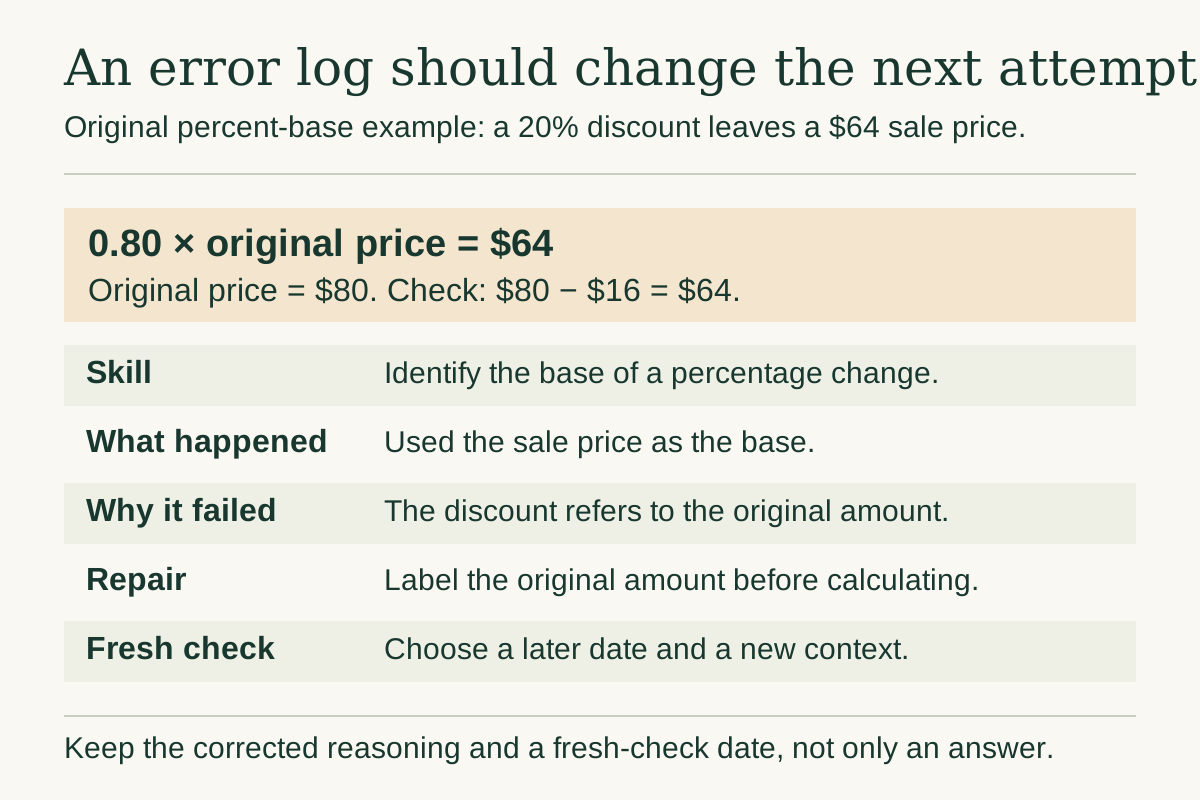
Use five fields: the skill, what the student did, why it failed, the repair, and the date of a fresh check. For a percentage problem, the reason might be using the sale price as the percentage base. The repair could be writing “original amount” beside the variable before calculating. The fresh check then tests whether that behavior transfers to a different context.
Avoid “careless” as a final category. Ask what kind of care was missing. Did the student copy a sign incorrectly, answer for x when the question asked for 2x, or select a transition before reading the second sentence? Each calls for a different response. A vague label encourages vague advice such as “slow down,” which may not address the cause.
At the weekly meeting, pick one recurring error and one improvement. Ask the student to show a new example of the improvement. If the same mistake returns, inspect the repair rather than adding guilt. Perhaps the student memorized a solution instead of learning the relationship, or perhaps the checking step was too elaborate to remember. Change the method in response to the evidence.

Review explanations without confusing recognition with learning
Reading an answer explanation can feel easy because the difficult decisions have already been made. After reviewing it, close the explanation and ask the student to reconstruct the method. If they cannot decide where to start, the explanation hasn't yet become usable knowledge. Return to the point where the reasoning stopped making sense.
Use a delayed check on a later day. The student should solve a new problem that needs the same idea, without the original worked answer in view. This is an editorial study routine, not a claim about a guaranteed memory effect or score increase. Its practical purpose is to separate “I understood while watching” from “I can do it independently now.”
Keep old material visible through a few mixed questions. Labeling a set “linear equations” supplies a hint about the method. A mixed set removes that hint and asks the student to recognize the problem. When the student struggles only in mixed work, the next lesson may need to emphasize choosing a strategy rather than performing steps faster.
Don't insist that every explanation be long. A clear sentence plus a correct setup may show more understanding than a rehearsed paragraph. Ask what quantity is being found, why the method fits, and how the answer can be checked. If those questions are answered, move on. Review should improve future decisions, not become a performance for the parent.
Use full practice tests as checkpoints
A full practice test asks several questions at once: can the student sustain attention, use the tools, allocate time, and apply skills without advance labels? It isn't the best tool for every daily lesson. Between checkpoints, targeted work makes it easier to teach and inspect a specific gap.
For the twelve-week example, a baseline and two later checkpoints provide a possible structure. For the eight-week plan, a baseline, a middle checkpoint, and a final substantial check may fit. These are suggested schedules, not a required frequency. If review is unfinished, another test can create more data than the student can use.
Use a first-attempt official test when you want the cleanest comparison available. If questions are familiar, record that fact. Remembering an answer can improve a result without showing that the underlying skill transfers. A repeated test can still be useful practice, but it shouldn't silently become the evidence that preparation worked.
Compare conditions before interpreting differences. A quieter room, better device familiarity, or additional help can change the result. Then compare question-level behavior: are there fewer unsupported inferences, more correct equation setups, or fewer unfinished items? The score matters, but these details tell you what to do next. Our guide to understanding SAT scores and retakes covers the larger decision.
Give timing problems a specific diagnosis
“Too slow” describes an outcome. Find the cause. Some students spend a long time decoding a concept they haven't learned. Others can solve the problem but reread every choice because they distrust the answer. Others lose time to an unfamiliar calculator action or refuse to move past one difficult item.
For a concept gap, teach the concept before reducing the time limit. For indecision, have the student state what evidence would make an answer sufficient. For tool problems, practice the relevant tool separately on simple questions. For getting stuck, rehearse a decision to flag and move on while the current module remains available, consistent with the test interface.
Use short timed sets only after the student understands the target work. Begin with a manageable amount and inspect accuracy alongside completion. Finishing faster by guessing earlier isn't the same as solving efficiently. Ask which steps became shorter and why. A student who recognizes a familiar structure may save time without rushing.
Don't require every question to take an identical amount of time. Some tasks need a quick recognition; others need several steps. The goal is an effective overall allocation. If the student repeatedly spends a disproportionate share on one item, practice noticing that moment and making a deliberate choice. Parent reminders during the set won't be available on test day, so remove them during the check.
Adapt the plan to a busy week
Create a minimum version before a busy week arrives. It might be two twenty-minute sessions and a short review of three old errors. Decide which activities can disappear first. Long optional videos, duplicate question sets, and elaborate tracking are easier to remove than the independent check that shows whether learning happened.
A student working evenings may need one weekend session and short weekday practice. A student in a demanding sport season may need to shift the larger preparation block to a quieter month. Don't treat every week as interchangeable. A sensible calendar uses the time the student actually has rather than borrowing permanently from sleep or school assignments.
If the family travels, plan portable work that doesn't rely on a full testing setup. Reviewing a few previously studied relationships or explaining an original example aloud can maintain continuity. Save the full digital test for a suitable setting. A plane ride or shared hotel room may be a poor place to collect a result you intend to compare seriously.
After illness or an emergency, restart with one small task and reassess the date. Don't assume the missed work must all be recovered. The family may need to reduce the scope, postpone an optional attempt, or ask a school counselor for help understanding deadlines. The test timing guide can help separate a preferred date from a true requirement.
Agree on the parent's role before frustration builds
Ask your child what support is welcome. You might provide a quiet space, transport, a calendar reminder, or help finding official resources. The student might prefer to explain a difficult question to a teacher rather than a parent. That preference doesn't mean the family has failed to support preparation.
Write a simple agreement: the student chooses the weekly tasks and completes the work; the parent protects agreed time and handles agreed logistics; both review the plan at a fixed meeting. Include how reminders will work. One agreed reminder is easier to live with than repeated questions throughout the evening.
Keep the weekly meeting short. Ask what happened, what the work shows, and what should change. Avoid opening with “Did your score go up?” every week. Many useful changes appear first in a correct setup, a clearer explanation, or a session that no longer requires conflict. Those observations are real, even though they aren't proof of a future test result.
If every discussion turns into an argument, change the arrangement. A counselor, teacher, study group, or tutor may provide a less emotionally loaded point of contact. The parent can remain responsible for logistics without also judging every answer. For deciding whether paid help would solve a specific problem, use our guide to choosing SAT prep.
Decide whether the plan is working
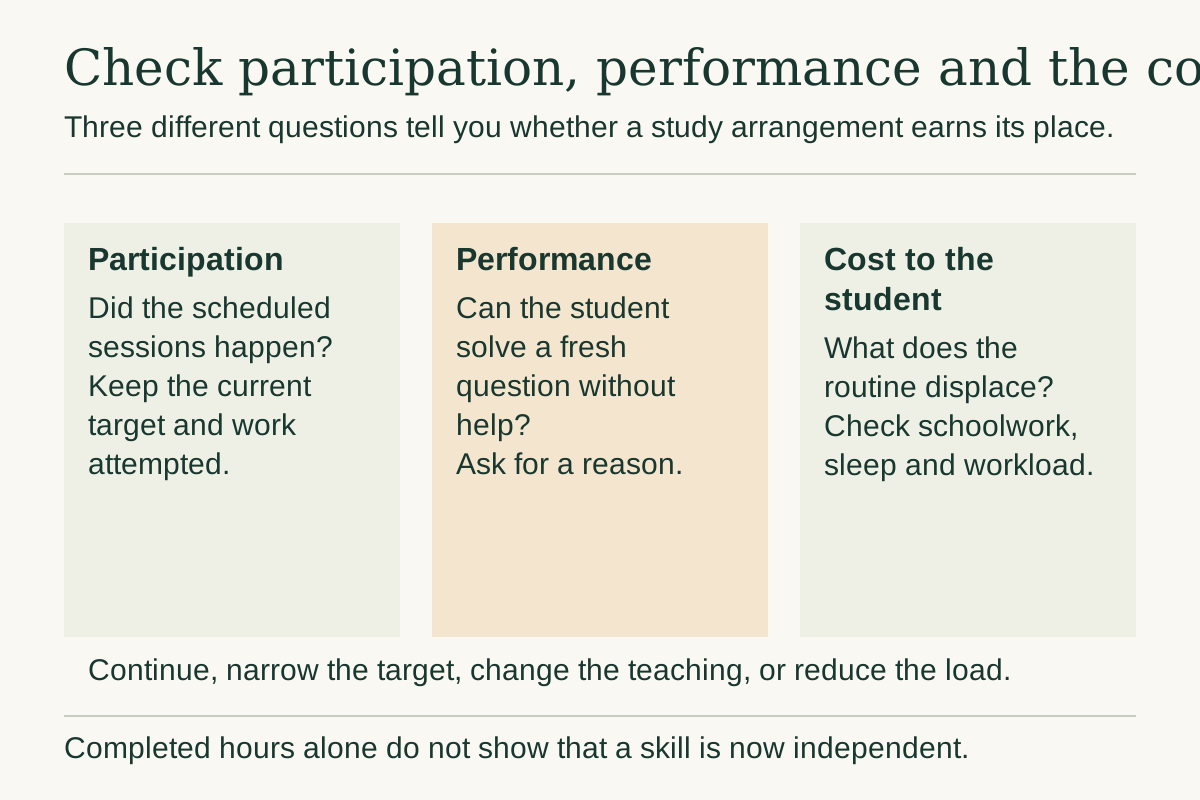
At each review date, examine three things: participation, independent performance, and cost to the rest of the student's life. A plan that produces completed sessions but no new independent skill needs a teaching change. A plan that improves practice performance while damaging schoolwork may need a workload change. Neither problem is solved automatically by adding hours.
Look for specific evidence. Can the student now identify the percentage base? Can they reject an answer because it overstates the passage? Can they set up a linear relationship without help? Save one or two fresh examples. They provide a clearer record than a general impression that the student seems more confident.
If progress is unclear, change one substantial element at a time when practical. Replace passive videos with guided problem solving, narrow a broad target, or seek help on an unfamiliar concept. Then check the result. Changing the schedule, app, tutor, and question source together makes it difficult to understand which change helped or created a new problem.
Do not treat a before-and-after score difference as proof that one product caused the improvement. School learning, familiarity, conditions, and ordinary variation may also contribute. The practical question is whether the current arrangement is helping this student perform useful work at an acceptable cost. Continue what earns its place, and remove what doesn't.
Troubleshoot the situation you actually have
If your child gets nearly every targeted question right but struggles on a full test, inspect recognition and timing. The practice sets may be telling the student which method to use. Put two familiar skills together, remove the labels, and ask the student to explain the choice of method before solving. If that check goes well, look at where time disappears during a longer session. Don't assume the only solution is harder questions.
If your child understands a lesson and forgets it by the next week, make the follow-up smaller and more explicit. Choose one fresh question the following day and another later in the week. Ask the student to reconstruct the setup without reopening the example. If they need the same hint each time, record the hint as the missing decision. The next lesson should teach that decision directly instead of repeating the whole explanation unchanged.
If your child studies often but avoids reviewing mistakes, reduce the new-question quota. Make the session's product one corrected explanation and one fresh solution. You can say, “Today we're checking whether that percent-base idea works on a different problem.” That is a clearer assignment than “Do more SAT.” It also makes completion possible without an argument about how long the student appeared to work.
If the plan works only when you sit beside the student, separate companionship from assistance. You might work quietly in the same room while the student completes a short set, then discuss it afterward. Keep hints out of the independent check. Gradually move that check to a separate space if the student is comfortable. The evidence you want is successful work under conditions the student can eventually manage alone.
If the student asks to stop preparation, listen before renegotiating. Find out whether the problem is the test's relevance, the schedule, the resource, a difficult concept, or the family dynamic. These are different decisions. A counselor can help confirm whether testing still serves the application plan. Continuing automatically is no more thoughtful than stopping automatically; use the actual purpose and costs to choose the next step.
Prepare the final week by reducing avoidable decisions
Use the final week to consolidate familiar methods and verify logistics. This is a poor moment to rebuild the entire plan around a dramatic new technique. Choose a small packet of representative errors and successful repairs. The student should recognize the ideas, explain them, and leave the session with a clear stopping point.
Confirm the official registration, device, identification, and arrival requirements for the student's administration. School Day and Weekend arrangements can differ. Our registration and test-day checklist explains the questions to check, while the current College Board instructions remain the authority for the student's test.
Protect ordinary routines. Plan transport, food, charging, and a reasonable evening before the test. Don't use a late-night practice score to decide whether the student deserves reassurance. If a serious practical problem appears, solve that problem or contact the appropriate official support channel instead of adding another lesson.
After the test, let the student decide how much to discuss immediately. Write down any logistical issue worth remembering, then return to ordinary life while waiting for results. The next decision should use the score report, actual deadlines, and the student's circumstances. For today, choose the first protected study slot and one skill the student can show you independently.