
Read an SAT score in three layers: what the student demonstrated, what a particular college or scholarship requires, and what another attempt would cost. A useful retake decision needs all three. A total score by itself cannot tell your family whether to register again.
Start with the two section scores and the actual report. Then check the policies for your student's application year. Consider another attempt when it serves a specific purpose, there is time to prepare differently, and the student can take it without sacrificing more valuable work. Stop when the purpose disappears or the cost outweighs the plausible benefit.
This guide explains the report and offers an original family decision process. The numerical examples and families below are hypothetical teaching examples, not student results or predictions. Official source links were checked on October 25, 2026. Colleges and scholarship programs can change their rules, so the institution's current instructions control your application.
Begin with the report, not the number in a message
A student may text “1260” before the family sees anything else. Resist evaluating the result immediately. Ask when they want to look at the report together and whether they want practical help, encouragement, or a little space first. You can interpret the document later that day. You cannot easily retract a disappointed reaction that turns a useful assessment into a family argument.
When you open the report, establish which assessment it represents, the administration date, and whether this was an official test or practice. Save the official report privately. Do not post a screenshot with the student's name, birth date, school, registration details, or account information in a parent group. A redacted summary is usually enough to ask a general question.
Create a short record containing the total, Reading and Writing score, Math score, test date, testing conditions, and the student's own account of what happened. Keep observation separate from interpretation. “The laptop lost power” describes an event. “The score should have been 100 points higher” makes a claim you cannot establish from the event alone.
The first conversation should end with a next step, even if that step is waiting until the weekend. Agree on when you will check school policies and whether the student wants to review practice. This prevents a vague concern from becoming daily questioning. A score report can guide a decision without taking over the household.
Understand the total and the two section scores
The SAT total runs from 400 to 1600. Reading and Writing and Math each run from 200 to 800. College Board's score report explanation also distinguishes SAT scores from PSAT-related assessments, whose scales are different. Check the assessment name before comparing reports.
An illustrative student with 610 Reading and Writing and 650 Math has a total of 1260 because 610 + 650 = 1260. Another student with 690 Reading and Writing and 570 Math also has 1260. Those totals match, but the preparation decisions may differ considerably. The first student might need a fairly balanced plan; the second might have a specific algebra gap worth investigating.
Do not convert the section gap into a diagnosis. A lower Math score does not prove that the student is weak at every mathematical skill. A higher Reading and Writing score does not mean that grammar needs no attention. Look for repeated errors and independent work before choosing what to study.
The total is useful when a policy uses a total. The sections are useful when a policy or preparation question concerns a section. Keep both visible in your planning notes. Rounding a student into “a 1200 student” hides meaningful differences and encourages adults to treat a temporary performance as a fixed identity.
If your child brings home a PSAT report, use it as information about preparation rather than silently relabeling it an SAT score. The parent guide to the digital SAT explains the surrounding test structure. This article focuses on what to do once a result exists.
Why a missed-question count cannot predict the score exactly
Families often ask how many questions a student can miss and still reach a target. There is no universal digital SAT conversion table that answers that question for every test. College Board explains that scoring accounts for characteristics of the questions, and that students with the same number of correct answers can receive different scores. See its scoring explanation.
That matters when a student leaves the test trying to reconstruct mistakes. They may remember a difficult item vividly, forget several routine items, and misjudge whether an answer was correct. Even an accurate count would not give you a universal scaled score. A confident online calculator cannot recover information it never received.
Use a remembered mistake as a future learning prompt, while respecting test security. For example, “I struggled with interpreting a function's intercept” points toward a skill to review using original or released practice. It does not justify sharing secure question wording or recreating the live item in a group chat.
The same caution applies to speculation about the second module. A student's impression that it felt easy or hard is not a reliable score report. Familiar content can feel easy because preparation worked. Unfamiliar vocabulary can feel hard even when the student answers correctly. Encourage the student to finish each module carefully rather than spending test time trying to identify a route.
After the test, replace score guessing with a simple note: one content issue, one pacing observation, one logistics issue. Then wait for the official result. That gives the next planning conversation something usable without pretending the family can calculate an unreleased score.
Read percentiles as comparisons with a named group
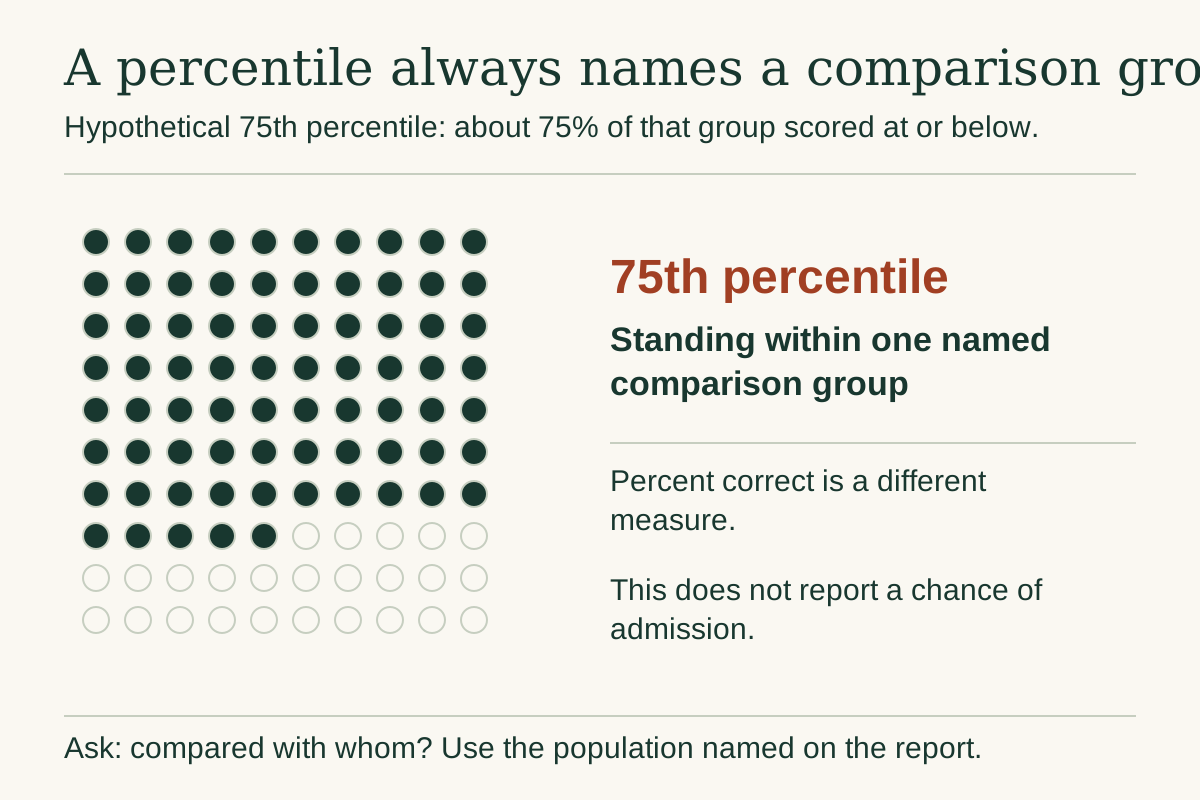
A percentile describes standing within a comparison group. It does not describe the percentage of questions answered correctly. College Board defines an SAT percentile in terms of students with equal or lower scores and publishes both nationally representative and user group percentiles. Those populations differ; the official percentile reference explains how.
If a hypothetical report places a student at the 75th percentile for a named comparison group, that means about 75 percent of that group scored at or below the student's score. It does not mean the student answered 75 percent of the test correctly. It also does not mean there is a 75 percent chance of admission anywhere.
When someone says a score is “above average,” ask above average among whom. All students in a grade, recent SAT test takers, applicants to a college, and enrolled students at that college are different groups. Comparisons can all be accurate while answering different questions.
For most family planning, the exact percentile is less useful than the report's section pattern and your student's actual application requirements. A percentile can provide context, particularly when adults are unfamiliar with the scale. It should not become a ladder that the student must keep climbing after the practical goal is already met.
Avoid comparing a current percentile to a parent's old percentile from memory. The comparison group, report, and test may differ. Ask instead what the current document says and what decision it changes. If it changes no decision, you do not need to spend the evening debating it.
Treat score ranges as a reason for measured interpretation
A score is an observation under a particular set of conditions. College Board's score guidance includes a score range describing likely variation under otherwise identical conditions. Consult the range shown for the student's report rather than importing a number from an old forum post.
This does not mean a disappointing result is meaningless. It means a small difference should not automatically become a story about declining ability or a miraculous new method. Suppose an illustrative student gets 1280, then 1300. The second total is higher, but those two results alone cannot isolate learning, normal variation, question differences, sleep, or familiarity.
Now suppose the same student can also solve previously difficult linear-equation problems independently, explain sentence boundaries, and manage a complete timed module more consistently. Those observations give you a stronger reason to believe preparation is improving relevant performance. Keep that evidence alongside the score rather than forcing the score to carry the whole interpretation.
The reverse matters too. A larger score rise after tutoring does not prove the tutor caused all of it. The student may have completed new coursework, used several resources, or become more comfortable with Bluebook. You can still judge the service useful without claiming a controlled experiment took place.
For family decisions, use a pattern of evidence. Consider recent unfamiliar practice, the official report, conditions, and the student's workload. Do not make a large purchase because of one low score or abandon an effective routine because a single result failed to rise. Ask what changed and what remains uncertain.
Use skill information to choose a small next task
A score report can narrow your investigation, but it should not dictate a giant study package. Begin with one weaker area, choose a few appropriate practice questions, and watch the student work independently. The task is to identify the obstacle precisely enough to select an intervention.
A student who misses questions involving ratios may understand the calculation once the equation is supplied. The missing step could be translating the situation into quantities. Another student may set up the relationship correctly but divide by the wrong quantity. Those students need different practice even if their report summaries look similar.
For Reading and Writing, distinguish comprehension from answer selection. Ask the student to explain what a short passage says before looking at choices. If the explanation is sound but the selected answer goes beyond the evidence, work on the relationship between claim and support. If the passage itself is misunderstood, begin with reading and vocabulary in context.
Use a compact review record: question source, skill, the student's original reasoning, what failed, a corrected explanation, and a fresh follow-up. Avoid an error log that becomes a second homework assignment. Two well-understood errors can guide the next week better than forty entries labeled “careless.”
A practical target might be “solve three fresh systems-of-equations questions and explain why each solution satisfies both equations.” That is observable. “Get better at Math” is too broad to direct a session. Our study plan for parents develops this approach into weekly routines with room for schoolwork and rest.
Define a useful score using actual destinations
There is no single good SAT score for every student. A useful score depends on the student's destinations, the relevant policies, and what else the family needs to accomplish. Start with a preliminary college list and any scholarship programs the family seriously intends to pursue.
Build a policy sheet using each institution's official admissions website. Record the application year, whether scores are required or considered, any program-specific conditions, accepted testing dates, reporting instructions, and the date you checked. Put uncertainty in a separate column. Do not let an unofficial summary silently become the policy.
If an institution publishes score distributions, read the label. Are these enrolled students, admitted students, or applicants? Does the group include only students who submitted scores? Is the report for the same campus or program? Those details determine what the numbers describe. They do not create a personal admission probability.
Suppose a hypothetical college reports a middle range among enrolled score submitters. A student above the range has not earned guaranteed admission. A student below it has not been mathematically rejected by the table. The distribution describes a selected group from a past period; it does not reveal the full decision rule for the current applicant.
Ask a narrower question: does the score satisfy a stated requirement, add relevant information, or create an opportunity worth a reasonable amount of effort? If the family cannot name that opportunity, another attempt may be responding to comparison rather than need. Set the goal before paying for preparation.
Separate admissions, merit aid, and affordability
An admissions testing policy and a scholarship rule can be different even within the same institution. Treat them as separate rows in your planning sheet. A college might have one rule for application review and a different process for a particular award. Verify both directly instead of assuming one word, such as “optional,” covers every decision.
For a scholarship, record whether the score is an eligibility threshold, part of competitive selection, or one consideration among several. Also record any GPA requirement, residency condition, application, deadline, and renewal criteria. An award advertised as “up to” a certain amount is not necessarily the amount every qualifying student receives.
Use net cost to compare options. In a hypothetical example, College A costs $31,000 per year after confirmed aid, while College B costs $24,000 after confirmed aid. A possible $3,000 annual award at College A would reduce its cost to $28,000, still $4,000 above College B. A bigger scholarship headline does not automatically identify the cheaper college.
Keep unconfirmed awards out of the guaranteed budget. You can build a second scenario showing what would happen if an award is received, but label it conditional. For a renewable award, check what is required each year and whether the amount is fixed. Four times an annual headline can overstate the benefit when conditions are ignored.
A retake aimed at an award can be sensible, but only after confirming the rule and the latest acceptable test. The family needs to know whether the potential benefit exists before trying to price the effort. If the policy is unclear, ask the institution a precise question and retain its answer.
Understand superscoring before comparing attempts
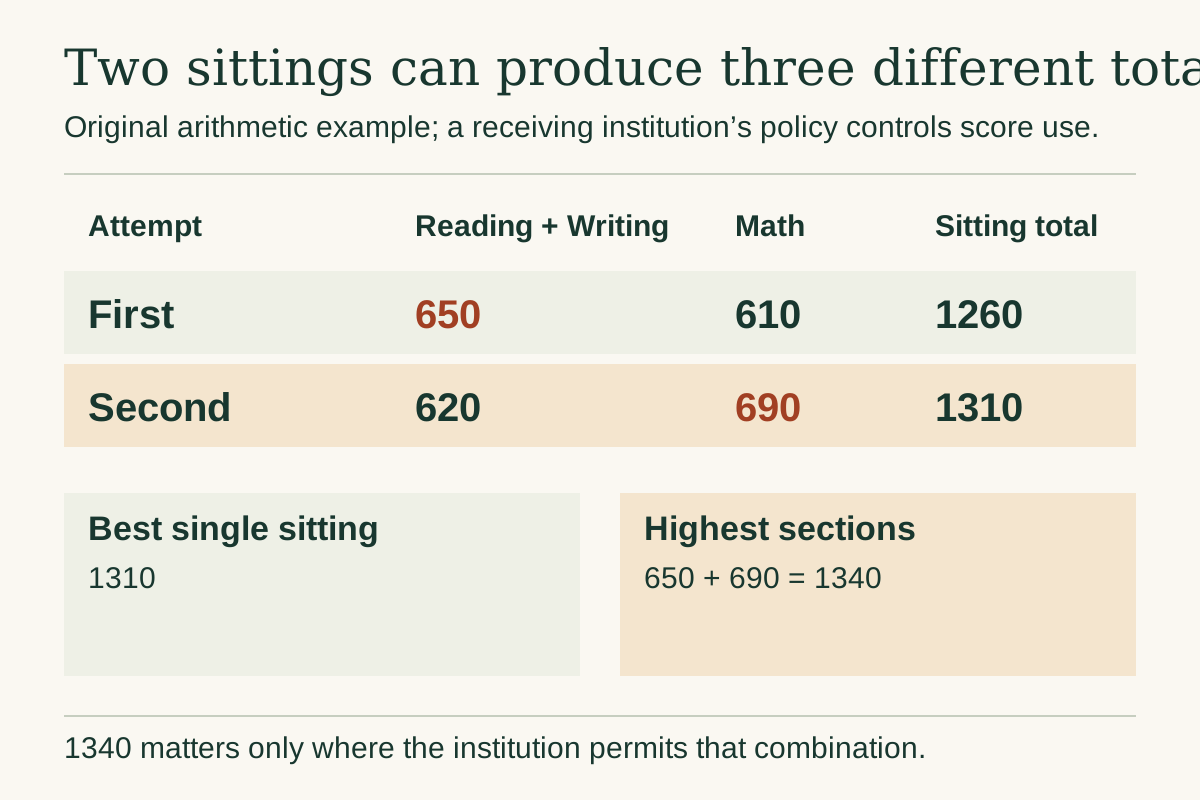
Superscoring means that an institution considers the highest relevant section scores across test dates according to its own policy. College Board explains the concept in its superscore guide, while reminding families to check each college's score-use policy. Do not assume that every institution or scholarship treats scores the same way.
Here is an original arithmetic example:
| Attempt | Reading and Writing | Math | Single-date total |
|---|---|---|---|
| First | 650 | 610 | 1260 |
| Second | 620 | 690 | 1310 |
The best single-date total is 1310. The highest section scores add to 650 + 690 = 1340. That 1340 is relevant only where the receiving institution's rules support that combination. It is not a third official administration, and the family should not describe it as the total earned in one sitting.
College Board's sending guidance for School Day scores distinguishes selecting test dates from sending isolated sections. Follow the receiving college's reporting instructions and the correct College Board workflow for the student's administration. A college's own application may ask students to enter scores in a specific way.
A stronger Math score accompanied by a slightly lower Reading and Writing result might still serve a superscoring institution. At another institution, the best single sitting may matter. Before calling an attempt successful or unsuccessful, connect it to the policy it was meant to serve.
Distinguish score selection from score cancellation
Choosing which eligible test dates to send, reporting scores on an application, and canceling a score are different actions. They have different consequences and instructions. Never click through one because a parent group used the terms interchangeably.
Cancellation can remove an option the student later wishes they had kept. A student who feels terrible after the test may be reacting to a few difficult questions rather than an accurately predicted total. Pause long enough to understand the policy and the reason for acting. If there was a genuine test-day problem, follow College Board's current reporting process promptly.
College Board's contact page gives procedures and deadlines for test-day concerns and score cancellation. Because those deadlines are operational rules, check the current page and the student's administration rather than relying on a remembered number of days. A School Day instruction should not automatically be applied to SAT Weekend.
If your reason is an application strategy, verify the college's score-use rule before taking an irreversible step. If your reason is equipment failure, document what happened and seek the relevant official guidance. If your reason is panic, give the student a calm conversation without converting that emotion into a permanent administrative decision.
Keep a dated note of any request, the channel used, and the confirmation received. Store only what you need. A family should be able to answer “what did we submit and what happened next?” without searching a public chat history or guessing which adult completed the form.
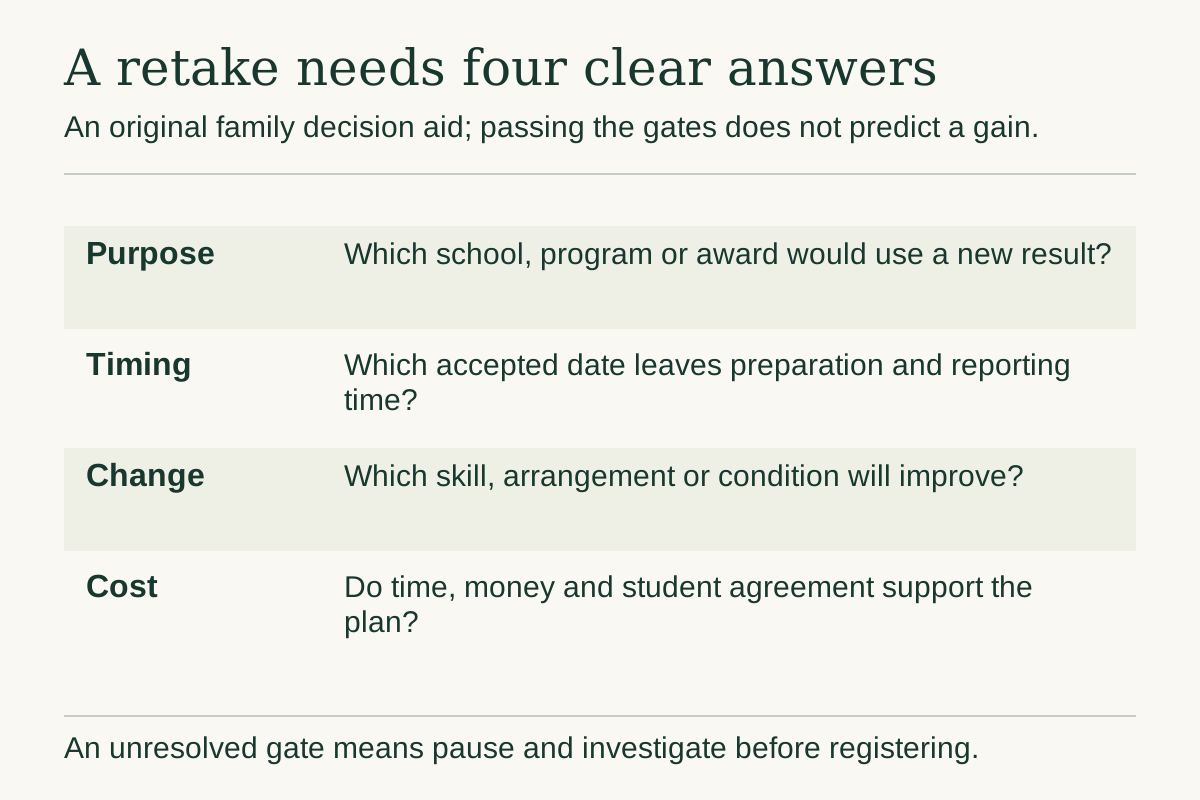
Use four gates before registering for a retake
Our editorial recommendation is to require four clear answers before paying for another attempt. This is a planning tool, not an official College Board rule or a score-gain formula.
First, identify the purpose. Name a required score submission, a verified award condition, a specific preparation milestone, or a meaningful opportunity to strengthen an application. “Everyone takes it three times” is not a purpose. A family custom does not become a student's obligation.
Second, confirm that the timing works. Check the test date, expected score release, institution's latest accepted test, and reporting requirements. A result that arrives too late for its purpose cannot solve that problem. Leave room for uncertainty instead of treating the last possible date as a comfortable default.
Third, name what will change in preparation or conditions. A new attempt should have a reason to be informative. That could be completed coursework, a repaired technical problem, targeted work on a diagnosed skill, or practice with an approved accommodation. Merely scheduling another Saturday does not create learning.
Fourth, check the cost to the student and family. Include fees, transport, prep, school conflicts, sleep, and the student's willingness to engage. A financially affordable test can still be expensive in time. A student nearing application deadlines may need that time for an essay, portfolio, class, or simply recovery.
If one gate fails, pause. You may be able to fix it, or you may decide to stop. Either outcome is more defensible than registering first and trying to invent the reason afterward.
Work through three hypothetical retake decisions
Consider Maya, a hypothetical junior with 1180. She wants to investigate engineering programs but has not yet built a college list. Recent work shows persistent difficulty turning word problems into equations. Her family has time for a modest routine and no urgent score deadline.
Maya's next step is to clarify destinations and study the identified skill. An immediate retake would offer little time to change anything. The family can reserve a future decision date without committing to a score promise. After several weeks, they can review fresh practice and decide whether another administration has a useful role.
Now consider Luis, a hypothetical senior with 1370 and a verified scholarship rule that requires a particular total by a stated deadline. His recent unfamiliar practice is consistently close to that threshold, he wants to try again, and there is an accepted test date with enough reporting time. A retake may have a concrete purpose.
Luis's family should still avoid treating the award as guaranteed. They can cap prep spending, confirm whether the rule uses a single sitting or another policy, and make an affordability plan that works if the score does not arrive. The decision is sensible because the opportunity is real, not because success is certain.
Finally, consider Aisha, a hypothetical senior with 1490, strong course demands, and no verified benefit from a higher score at her chosen destinations. She is exhausted and wants to finish her applications. Another attempt would mainly satisfy a parent's preference for a round number. Stopping protects time for work with a clearer purpose.
The totals in these examples do not establish rules for other students. Purpose, policy, time, and willingness explain the different decisions. Change those conditions and the recommendation may change as well.
Put a ceiling on the retake budget
Write a maximum budget before shopping for help. Include the registration cost shown in the current official checkout, travel, possible accommodation, materials, and paid instruction. Keep these categories separate so that a cheap test does not disguise an expensive preparation package.
Here is an illustrative household calculation, using invented prices rather than current market quotes. Suppose transport costs $40, a book costs $25, and four tutoring sessions cost $75 each. Those items total $365 before the official registration charge: $40 + $25 + 4 × $75. If the family adds a $120 hotel stay, the subtotal becomes $485.
That arithmetic does not tell you whether tutoring is worth buying. It makes the commitment visible. Ask what each purchase is supposed to change and whether a smaller option can do that job. A student who needs help understanding one recurring concept may benefit from a focused lesson more than a broad subscription they rarely use.
Use a second ceiling for time. If the student can reasonably allocate three hours per week for six weeks, that creates eighteen hours. Decide how much goes to independent practice, review, instruction, and a full rehearsal. Buying a program requiring ten hours a week will not manufacture the extra seven hours.
For scholarship decisions, avoid inventing a probability of success to justify the spend. If there is no credible basis for estimating that probability, say so. You can compare scenarios and choose an affordable attempt without dressing uncertainty as a precise expected return. The budget should still be acceptable if the target is missed.
Judge preparation by evidence beyond completed hours
Hours tell you what time was allocated. They do not tell you what the student learned. Before a retake, look for independent performance on unfamiliar material and the ability to explain a correction without immediately looking at the solution.
A useful progress check begins with the prior obstacle. If a student confused percentage change with percentage of a total, give a fresh problem in a different setting. Ask them to identify the original amount, calculate the change, and explain the denominator. A memorized solution to last week's question is not enough evidence that the relationship now makes sense.
For a reading question, ask which words in the passage support the answer and why a tempting alternative goes too far. For grammar, ask the student to locate the clauses and explain the punctuation. Keep the task narrow enough that the explanation reveals the decision rather than inviting a vague recital of test tips.
Track conditions when comparing practice. A quiet full test, an interrupted module, and five questions completed while texting are different observations. Do not combine their results into a smooth progress line without noting those differences. Reusing a test can be useful for review, but its score is less informative as a fresh estimate once answers are familiar.
A family can use a brief weekly check: what became easier, what still fails, and what is the next experiment? If paid help is involved, ask the instructor to answer the same questions. Our guide to choosing SAT prep gives a more detailed way to evaluate instruction and spending.
Decide how to talk about a disappointing result
Begin with what the student wants to say. “How are you feeling about it?” is usually more useful than “What happened?” The second question can sound like an accusation before anyone has read the report. Your child may be upset, relieved, indifferent, or proud of progress you have not noticed yet.
Acknowledge the work without inventing a better score. You can say, “I saw you follow the plan, and we can use this information to choose what comes next.” Avoid “You deserved 100 more points,” which turns encouragement into an unsupported measurement claim. Effort deserves recognition even when the result is disappointing.
If the student wants to stop, ask what stopping would solve and what it would leave unresolved. Perhaps the target no longer serves any school. Perhaps the plan was too heavy. Perhaps there is a clear opportunity but the current method is failing. Listen for the specific constraint before proposing more of the same.
If the parent is more disappointed than the student, separate that reaction from the planning session. Talk to another adult privately rather than asking your child to manage your anxiety. Comparisons with siblings, classmates, or a parent's old test history rarely identify a useful next task.
End with one agreed action and one time boundary. “On Sunday we will spend twenty minutes checking the three scholarship policies, then decide whether to register” is concrete. “We need to get serious” leaves every future evening vulnerable to another argument. A bounded decision can be both ambitious and humane.

Set stopping rules before another attempt
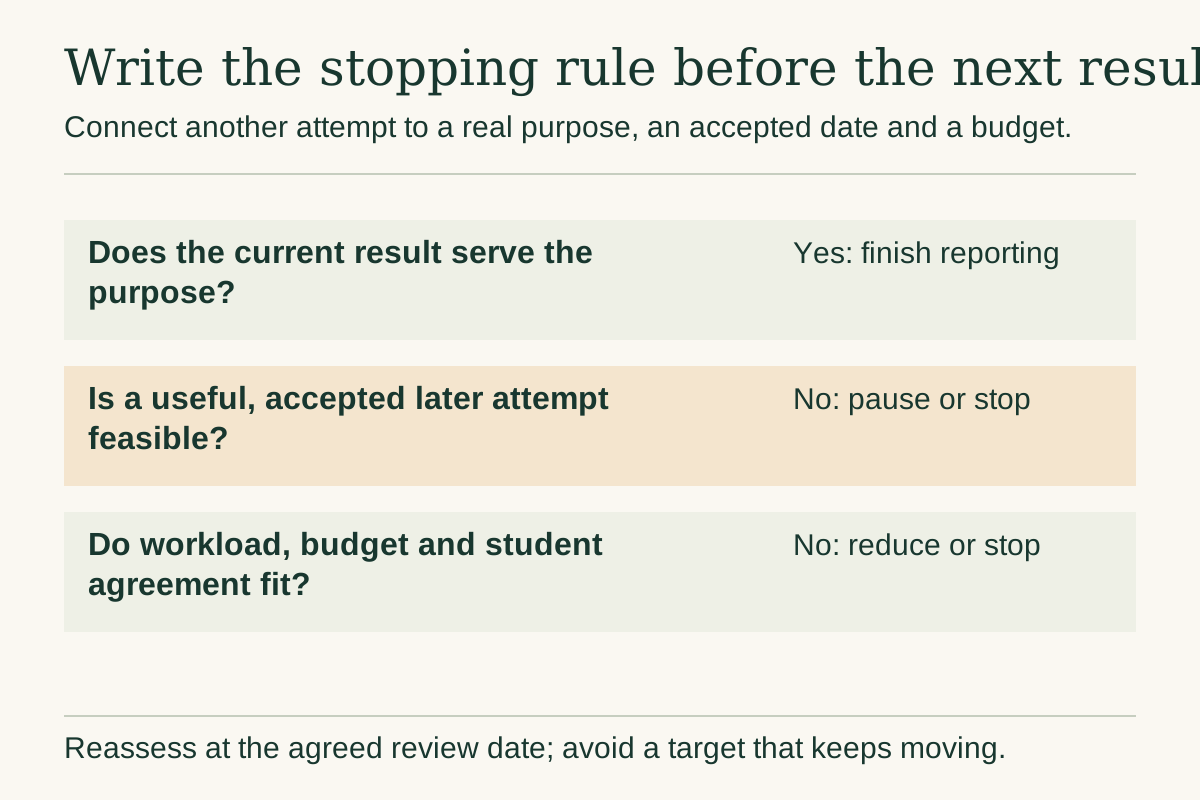
A stopping rule protects the student from a target that moves every time it is reached. Agree in advance on the practical goal, the maximum planned attempts or review date, the spending ceiling, and the conditions that would make the family reconsider.
The rule might be “we will reassess after this administration using the actual college policies and the workload for applications.” It need not be an inflexible numerical limit. Leave room for a major technical issue or a genuinely new requirement. But make reconsideration explicit rather than quietly adding another test whenever a parent feels nervous.
Useful reasons to stop include meeting the purpose, losing the relevant deadline, having no new preparation hypothesis, and facing a more urgent obligation. A student can also decide that the remaining possible benefit does not justify the experience. Their view belongs in the decision because they are the person doing the work.
Stopping does not mean declaring that the student has reached a permanent ceiling. It means choosing where to spend the next month. Strong schoolwork, thoughtful applications, paid work, family responsibilities, and rest are all real uses of time. The SAT is one project within that life.
Write the decision in plain language. “No further SAT preparation is planned for this application cycle; we will complete reporting tasks by the verified deadlines.” That statement closes the study loop while preserving necessary administration. It is more helpful than leaving a vague possibility hanging over every weekend.
Handle missing scores and unusual reports separately
An absent score is an administrative problem before it is a preparation problem. Confirm that the student is using the correct account, assessment, and administration date. Compare the current official score release information with the student's circumstances. Avoid assuming that every administration follows the same release schedule.
If the account shows a hold, delay, or other status, read the actual message. Follow the official help path and keep a private record of the inquiry. Do not interpret an unfamiliar status as evidence of wrongdoing or spread speculation in a parent group. The family may not yet know the cause.
If a college deadline is near, the student should ask the institution how to handle the pending result. Explain the situation factually, include the relevant date, and ask what documentation or later update is accepted. Do not promise an admissions office a release date College Board has not confirmed.
A parent can help organize documents and draft a question, while leaving the student's identity clear. Use official contact channels and avoid sending full identification documents unless the organization specifically requires them through an appropriate process. A public social-media post is rarely the right place for a score report or account screenshot.
Keep the decision about another attempt separate until you understand the current report. Registering reflexively because a score is late may create more cost without solving the deadline. Once the administrative situation is clear, return to the same four gates: purpose, timing, changed preparation, and cost.
Build a score decision sheet you can actually use
A single page is enough for most families. Put the student's current total and section scores at the top, along with the test date and a short conditions note. Add a small table for the destinations that are genuinely under consideration.
| Field | What to write |
|---|---|
| Destination | Exact campus, program, or award |
| Policy | Current requirement and official source |
| Deadline | Latest accepted test and reporting instruction |
| Score purpose | Requirement, possible context, or verified award rule |
| Next action | Send, ask a question, study, retake, or stop |
| Owner | Student, parent, counselor, or institution |
The “owner” column prevents a common household failure: two adults assume the other one handled a task. It also prevents the parent from taking over every step. The student can check the application portal while a parent handles transport or an agreed budget question.
Under the table, write the retake decision and its reason in two sentences. For example, “We plan one further attempt because College X accepts that date and the student wants to address a specific algebra gap. We will use six weeks of targeted practice within the agreed budget, then stop and finish reporting.” The details must come from your real situation, not this example.
Finally, add a review date. Policies can change, a college list can shrink, and an unexpected school commitment can alter the schedule. A review date lets you adapt without reopening the question every day. Once the sheet answers the practical problem, put it away and return to the work the student chose.
Finish reporting without reopening the whole decision
Once the family decides whether to retake, make a separate list of reporting tasks. For each institution, record what the student must enter in the application, whether an official report is required at that stage, and how to confirm receipt. Use the institution's own instructions. A general score-sending explanation does not replace a particular university's application process.
Have the student read each form field carefully. A field asking for the highest single-date total is different from one asking for section results by date. Copying a superscore into every box can create an inaccurate record even when the student has calculated that superscore correctly. Keep the official reports available while completing the form so the dates and sections remain attached to their actual administrations.
Treat a report order and confirmed receipt as separate states. Save the necessary order confirmation, then check the application portal according to the institution's guidance. If something appears missing, ask the appropriate office a concise factual question rather than immediately paying to send the same report again. Include enough information to identify the application through the approved channel, while avoiding unnecessary documents.
Families with several applications can use a small status vocabulary: not required now, student entry complete, official report ordered, received, or question pending. That is easier to interpret than a single checkbox labeled “scores done.” It also reveals the last unresolved task without turning every college into a new SAT study discussion.
When the required reporting work is complete, close the record. Retain the reports and confirmations securely for the application process, but remove reminders that no longer serve a purpose. A completed administrative task should give the student some attention back, not trigger another debate about whether the number could have been higher.
Questions parents ask before a retake
Should we retake if the score went down?
A decrease is a reason to investigate, not an automatic instruction to register. Compare sections, conditions, and recent unfamiliar practice. Then ask whether another accepted attempt serves a specific purpose. If the family has no changed preparation plan and the student's applications need attention, stopping can be the better decision. If a documented problem can be addressed and the opportunity remains useful, another attempt may make sense.
Should we focus only on the weaker section?
Give the weaker section deliberate attention when you have identified a real gap, but preserve enough practice in the other section to maintain familiarity. The right balance depends on the student's independent work and the receiving institution's policy. A lower section number alone does not identify which topic to teach. Start with a few representative questions and the student's reasoning.
Does a superscore guarantee that colleges ignore weaker sittings?
No family should infer that from the word alone. Read the institution's current explanation, required reports, and application instructions. Superscoring describes a score-use method; it does not reveal every part of an admissions decision. Where the wording is unclear, ask the institution directly rather than filling the gap with reassurance from an unrelated college's website.
Is there a score high enough to guarantee a scholarship?
Only a specific program's verified terms can answer whether a score meets an award condition, and other requirements may apply. Do not substitute a general internet threshold for that policy. Record the award year, eligibility, selection method, deadline, amount, and renewal conditions. Build a family budget that distinguishes confirmed aid from an award the student might receive.
What should we do this week?
Read the report together at a time the student agrees to. Check the real destinations, identify one unresolved question, and apply the four retake gates. If the answer is to prepare, choose a narrow skill and a sustainable routine. If the answer is to stop, complete the reporting tasks and close the project. The next useful step should be small enough to finish and clear enough that everyone knows when it is done.