
Choose a first SAT date that leaves room to learn from the result and, if useful, take another test before the student's actual score deadline. For many families, a first attempt during junior year is a sensible planning option. The right month depends on course coverage, practice evidence, school testing opportunities, support arrangements, and the deadlines of the institutions that matter to your child.
Do not choose a date because everyone in a group chat seems to be choosing it. A spring athlete, a student working weekends, an international applicant, and a senior facing an early deadline have different calendars. The best date is the one that fits a clear purpose and a workable preparation period, with a realistic fallback.
This guide offers a method for building that calendar. Suggested timelines and hypothetical family examples are editorial planning tools, not official requirements or predictions of score improvement. Official dates were checked on October 25, 2026. Always reopen College Board's calendar and the relevant institution's current policy before registering or relying on a deadline.
Work backward from the deadline that actually matters
Begin with the date by which the score must be usable for its intended purpose. An application deadline, a scholarship deadline, the last accepted test administration, and the deadline for an official score report can be different things. Treating them as interchangeable can make an apparently comfortable plan fail.
For each institution, find the current admissions page for the student's application cycle. Look for whether testing is required, optional, or handled in another stated way. Then check whether applicants may self-report, whether an official report is required at application or later, and whether a particular test date is the last one accepted. Check separate programs and scholarships individually.
Create one row per meaningful opportunity. Record the policy link and the date you checked it. If the page does not answer a question, ask the admissions or scholarship office through its published channel. A parent can help the student prepare that question, but do not assume that a general answer about admission also covers a competitive scholarship.
Here is a useful question template: “For an applicant entering in [year] and applying under [plan], what is the last SAT administration you accept, and how must scores be provided by your deadline?” Replace the bracketed details before using it. The goal is a specific answer about the student's situation, rather than a vague assurance that later scores are usually fine.
Once you know the real boundary, work backward through score release, any required delivery and processing, the test date, and registration. Add time for uncertainty rather than placing every step on its last possible day. A plan with slack is easier to manage than one that depends on several things happening immediately.
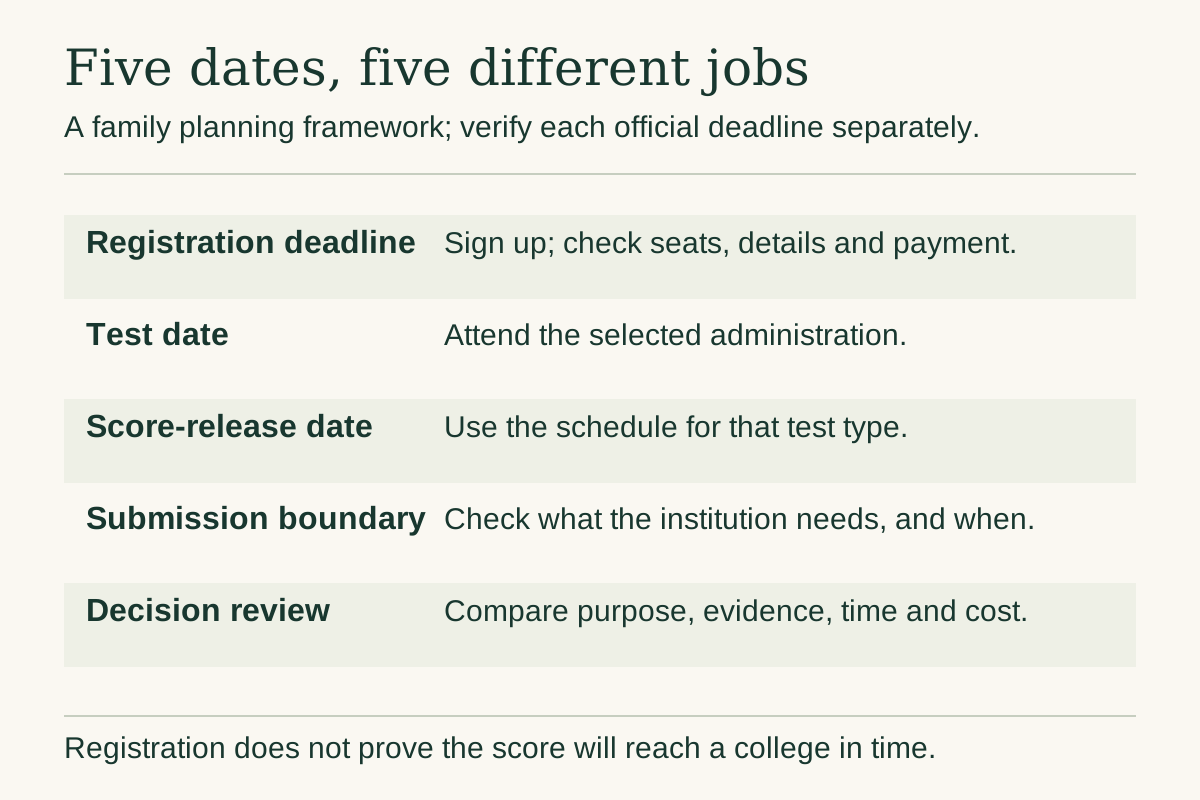
Keep five dates separate
A testing calendar needs more than a large circle around Saturday morning. The following distinctions prevent many planning errors.
| Date | What it means | What to check |
|---|---|---|
| Registration deadline | The normal deadline to sign up for an administration | Seat availability, correct student details, and payment or waiver status |
| Test date | When the student sits the administration | School conflicts, travel, device and support arrangements |
| Score-release date | When College Board schedules results for that administration | The published table for that test type |
| Score-submission boundary | When or how the institution needs the result | Self-reporting versus official delivery and any last accepted test |
| Decision review | When your family decides whether another attempt is worthwhile | Practice evidence, remaining time, purpose and cost |
Registration does not establish that a needed score will arrive in time. Score release does not establish that a college has processed an official report. An application submitted on time does not settle whether a later result will be considered. Each step needs its own evidence.
Put the family review on the calendar before results arrive. Otherwise the retake decision can be driven by a disappointing moment, a friend's result, or a registration deadline that suddenly feels urgent. A scheduled review gives you a place to compare the report with the purpose you agreed on earlier.
Avoid making the shared calendar more detailed than the family will maintain. A few confirmed dates with clear labels beat dozens of colored entries that no one trusts. Keep a link to the official source beside any deadline likely to change, and distinguish a tentative plan from a completed registration.
Understand the current calendar before choosing a season
As of October 25, 2026, College Board lists the following upcoming SAT Weekend dates and regular registration deadlines. The November regular deadline has already passed; its listed late-registration deadline is October 27. Availability and applicable conditions still need checking in the student's account. The source is College Board's SAT dates and deadlines.
| SAT Weekend test | Regular registration deadline | Listed late-registration deadline |
|---|---|---|
| November 7, 2026 | October 23, 2026 | October 27, 2026 |
| December 5, 2026 | November 20, 2026 | November 24, 2026 |
| March 6, 2027 | February 19, 2027 | February 23, 2027 |
| May 1, 2027 | April 16, 2027 | April 20, 2027 |
| June 5, 2027 | May 21, 2027 | May 25, 2027 |
The same official page says Weekend deadlines expire at 11:59 p.m. U.S. Eastern Time. A family outside that time zone should convert deliberately and aim to finish earlier. Do not interpret the deadline in the time zone of your device merely because the website is open there.
This table is a checked snapshot, not an evergreen promise. If you are reading after the publication date, reopen the official calendar. Do not infer that an administration exists in a month missing from the table, or copy a previous year's dates into a future plan.
When planning beyond the published registration period, use broad seasonal placeholders until dates and availability are confirmed. “Possible fall retake” is honest. A specific appointment that has not been published or booked can create false confidence for everyone using the family calendar.
Junior year is a planning window, not a rule
A first official attempt during junior year can leave time to review a result before senior-year applications. That is an editorial scheduling advantage, not a requirement that every junior test in the same month. Course sequence and actual readiness matter more than the label on the school year.
A student taking a relevant math course in spring may prefer to test after more of that material has been taught. Another student may already know the material and have a quieter winter preparation period. A third may have a school-day opportunity that fits better than a separate weekend trip. Compare the real options rather than applying one generic timeline.
Start with a fresh official practice test after basic familiarization. Look at which errors reflect material the student has not studied, which reflect shaky foundations, and which reflect timing or misreading. These patterns help decide whether the next available date is a useful target or an unnecessary rush.
A junior who is not ready for a first official administration can still make progress now. The family can resolve support arrangements, learn the digital environment, build core skills, and choose a later date. Waiting without a plan is different from choosing a later date for a clear reason.
Conversely, do not postpone indefinitely in search of a perfect practice score. If testing serves an actual purpose, the student has prepared under realistic conditions, and the date leaves a fallback, an official attempt can be reasonable. Establish what would justify registering rather than allowing anxiety to set a standard that keeps moving.
What should ninth- and tenth-grade families do?
For most early high-school planning, strengthen school learning and learn the testing landscape before building an intensive SAT schedule. This is a recommendation about priorities, not a claim that an earlier attempt is never useful. Some students have a specific program requirement or another clear reason to test sooner.
A ninth-grade family can ask what the student's school offers, which courses are coming next, and whether there are support needs that should be discussed early. Encourage reading, careful writing, and secure mathematics in the ordinary curriculum. Do not turn every homework difficulty into an admissions emergency.
A tenth-grade family may find an initial overview useful. Explore the test format and learn what school-based assessments are planned. If a practice result is used, interpret it in light of material not yet taught. A score on an early diagnostic is a description of that occasion, not a ceiling on future performance.
Families sometimes choose an early official test because they want a benchmark. Before paying, ask what a fresh official practice test would fail to provide for that immediate decision. If there is no specific reason an official administration is needed, using practice material first may be the simpler choice.
Keep the amount of preparation proportional to the student's purpose and current stage. An elaborate two-year regimen can crowd out the school learning that preparation is supposed to draw on. Review the plan when course coverage, institutional goals, or the student's needs become clearer.
Use school-day testing as a real option
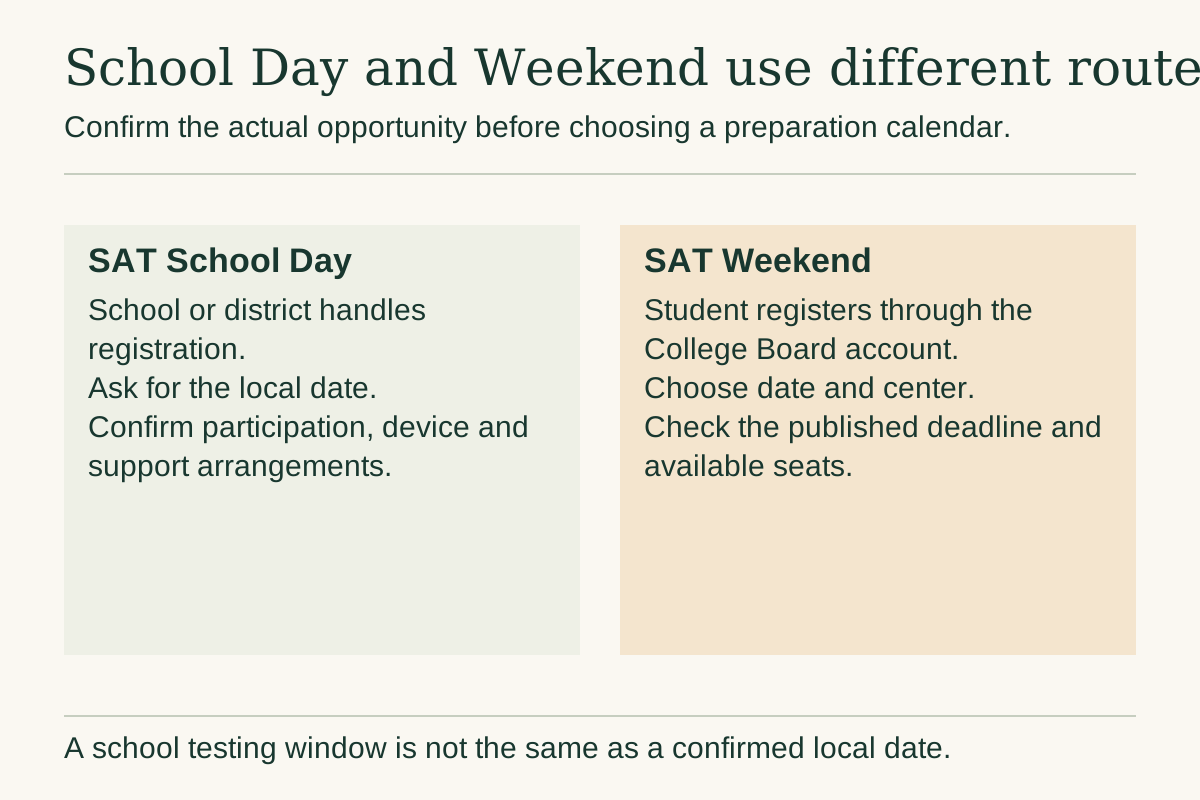
SAT School Day is arranged through participating schools or districts. College Board states that students taking in-school assessments do not register on their own; schools or districts handle that process. Its in-school assessment information provides the broader context.
Ask the school which assessment it offers, which students participate, the actual local test date, what it costs if anything, which device is used, and how accommodations or other permitted support will be arranged. Do not assume that a national testing window is the student's appointment. The local school determines its schedule within the applicable arrangements.
School-day testing can reduce some transport and scheduling burdens. It may also fall during a demanding academic period. A weekend date can offer different preparation spacing but require travel or conflict with work. Neither format automatically wins for every family.
If your child already has a school-day administration scheduled, include it before booking another test. You may decide that the school-day result should inform any later weekend plan. Alternatively, a specific institutional deadline may make another date useful. The point is to avoid accidentally stacking tests without asking what each one adds.
Confirm how the student will access results and what identification or account steps the school expects. Keep school instructions with the family calendar. If a student changes schools, learns remotely, or is homeschooled, ask the relevant school or official support channel about the actual available route rather than assuming participation.
Do not confuse a testing window with a score-release schedule
Weekend and school-day results can follow different schedules. College Board's score-release page lists the relevant tables. For in-school testing, release dates are tied to answer-submission groups and the assessment arrangements; the day your child sat at a desk does not always tell the whole story.
For the upcoming Weekend administrations, the published student release dates are November 20 for November 7, December 18 for December 5, March 19 for March 6, May 14 for May 1, and June 21 for June 5. Recheck the table when making a decision, particularly if you need a result near another deadline.
Build your family review around the scheduled release, then allow for an individual delay. A family can know the planned date without promising that every student's score will appear at a particular hour. Avoid repeated refreshing becoming the day's main activity.
If a result is delayed, follow the official support directions and the institution's process for reporting the situation if needed. Keep a record of relevant confirmations. Do not assume that buying a faster report option can make an unreleased score exist or make a college consider a result outside its policy.
When a release date overlaps a registration deadline, decide in advance what information you need. You may have to weigh a registration before knowing every result. That is a genuine tradeoff involving money, availability, and uncertainty. Write down the reason for the choice so it does not later look like a promise about the unknown score.
Reserve room for review between attempts
A second test is useful only if it has a plausible job. More attempts do not automatically mean more learning. If your child takes one test, receives no targeted feedback or instruction, and immediately takes another, the family may have created another measurement without changing the preparation.
Leave enough time to receive the first result, inspect the relevant evidence, address selected weaknesses, and check fresh work. The right interval depends on the problem. A narrow punctuation rule may be teachable in a few focused sessions. Missing algebra foundations may require a longer period of instruction and practice.
Ask what should be different by the next attempt. A useful answer describes behavior: “She can set up fixed-and-variable-cost problems independently,” or “He has a repeatable way to support reading answers with evidence.” “We hope the next test feels easier” is not an intervention.
Use a fresh practice assessment when the student has had a meaningful learning period and when the result will inform the decision. Repeatedly testing every weekend can consume material and review time. A familiar practice score also needs a different interpretation from a fresh one.
Our guide to understanding scores and retakes develops the decision in more detail. For scheduling, keep one question central: does the calendar leave a credible opportunity to change the things that made the first attempt difficult?
Build an eight- to twelve-week preparation block only if it fits
A preparation block of roughly two or three months can be a useful planning template, but it is not a guaranteed improvement formula or a required minimum. Some students need less time for a narrow issue; others need longer for foundational learning. Begin with the student's actual week.
List school assignments, exams, paid work, sports, performances, family duties, travel, and sleep. Then find a few repeatable slots. Include review and instruction as well as question answering. A schedule that includes only tests measures repeatedly without explicitly making room for learning.
Divide the block into a starting diagnosis, targeted learning, mixed practice, and a final readiness check. Keep those phases flexible. If the starting diagnosis reveals that an essential topic is unfamiliar, extend teaching rather than pretending the calendar proves readiness.
A parent can help by removing practical friction. Arrange a quiet place, solve transport issues, and make sure the device is available. The student should still own the attempts and explain the next skill focus. A calendar full of parent-managed tasks is not evidence that independent practice is happening.
At a weekly check-in, compare planned work with completed work and what became clearer. If the block repeatedly fails, repair the assumption. Perhaps the session starts too late, the assigned task is unclear, or the workload is too large. Adjusting early protects both preparation quality and family trust.
See our SAT study plan for parents for a fuller routine. Use its structure to fit the student, rather than treating the number of weeks as a promise about a score.

A hypothetical junior-year plan with a spring first attempt
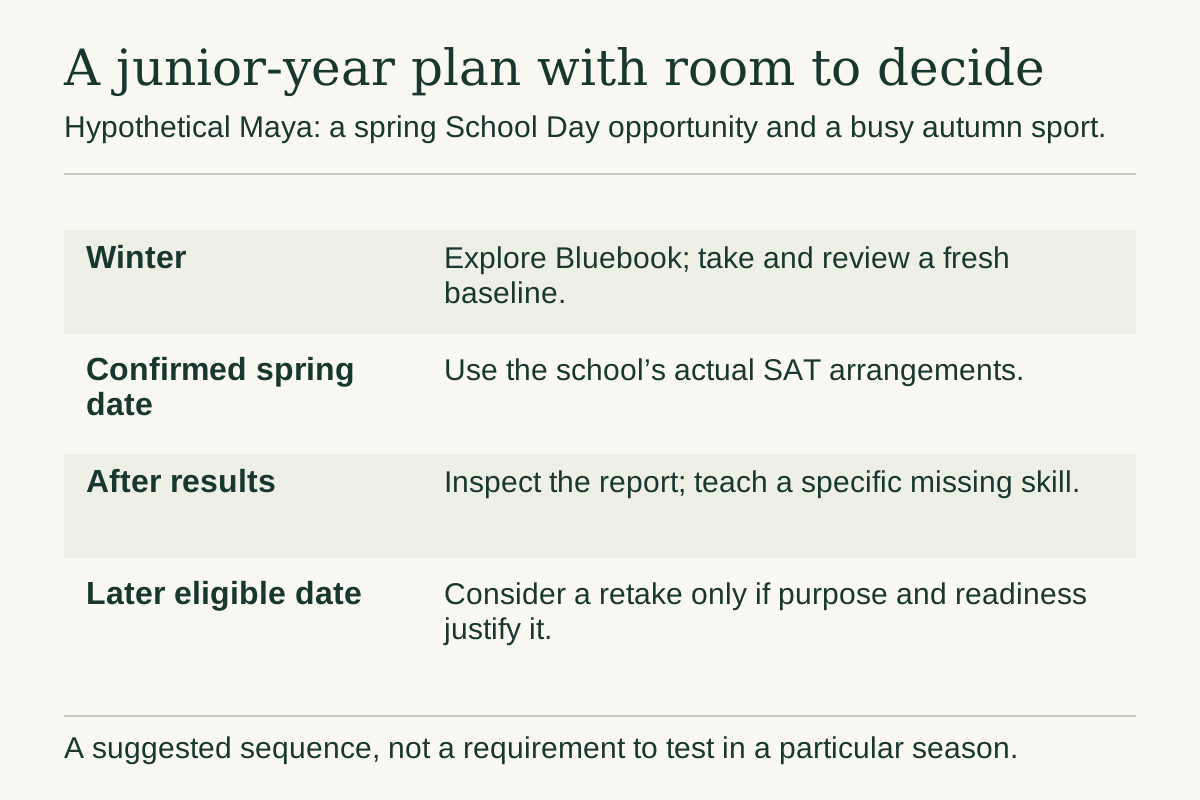
Imagine a hypothetical junior, Maya, who has a spring school-day opportunity, a demanding autumn sport, and no application deadline until senior year. Her family first checks that the school-day test is actually scheduled for her and asks about the local arrangements. They do not book a separate test merely because a friend has registered.
During winter, Maya explores Bluebook, takes a fresh official practice test, and reviews it. The result suggests she needs work on linear equations and evidence-based reading choices. The family agrees on several manageable practice slots and a short weekly conversation. This is an example of a planning process, not a reported student outcome.
Maya takes the school-day administration. When results become available, she compares them with her goals and the requirements the family has checked. If another attempt has a clear purpose, she identifies the specific skills to address and considers a later published Weekend date. If the result already serves the intended purpose, the family can stop or redirect effort elsewhere.
The plan has several protections. The first attempt is not tied to the final possible deadline. Preparation avoids the busiest sport period. The retake is conditional rather than inevitable. Most importantly, the family knows what decision each piece of information is supposed to inform.
Change one fact and the plan may change. If Maya needs accommodations that are not yet approved, support arrangements become an early priority. If the school-day date conflicts with a major commitment, the family asks the school about the applicable process rather than improvising. If an institution adds an earlier requirement, the deadline worksheet gets updated.
A hypothetical plan for a student working weekends
Consider a hypothetical student, Daniel, who works Saturdays to contribute to household expenses. A standard weekend plan has a real opportunity cost. His family asks whether the school offers an appropriate school-day administration and confirms how participation works.
Preparation also needs to respect his schedule. A long Saturday study session may be unrealistic even if a generic online plan recommends it. Daniel chooses shorter weekday blocks and an occasional longer session when work permits. His parent helps protect those blocks from other avoidable demands.
If a weekend test becomes necessary, the family checks the published calendar early and discusses the shift with the employer while there is time. They include lost earnings and transportation in the practical cost. The test fee alone does not describe what the attempt costs this household.
A retake decision should account for those same costs. Another attempt might be worthwhile for a defined opportunity, but it should not be booked automatically because another student is taking three tests. Daniel's time and obligations belong in the decision, alongside his practice evidence and deadlines.
This example illustrates why calendar advice should begin with the actual week. A plan can be academically plausible and practically impossible. The parent adds value by helping build a feasible arrangement, not by insisting that a template represents the student's level of commitment.
A hypothetical senior with an early application deadline
Now imagine a hypothetical senior, Priya, who starts planning in October and has an early application deadline approaching. Her first task is policy verification. She needs to know whether testing is required, which administration the institution accepts, and whether scores can arrive or be reported after the application itself.
If the institution's published policy excludes a later administration, a later test does not solve that particular application problem. It may still serve another institution or scholarship. Separate those purposes rather than treating every SAT attempt as useful for every application.
Priya also needs a realistic preparation decision. A short period can support targeted review, device readiness, and a clear pacing routine. It cannot guarantee that broad knowledge gaps will disappear before the next available date. Her family should distinguish what can be improved now from what would need a longer learning period.
If testing is optional for the relevant application, the submission decision requires its own consideration under the current policy. Do not interpret “optional” as a universal instruction either to submit or withhold. Look at the student's evidence, the institution's guidance, and any separate requirements.
The family then builds two plans: one for the approaching deadline using the information and eligible results available, and one for later opportunities if those still matter. That prevents an unresolved test decision from freezing the rest of the application work.
Put accommodations and device arrangements near the beginning
Some planning tasks need more lead time than ordinary registration. College Board's accommodations deadlines state that review can take up to seven weeks after required documentation is received, with additional time possible when further information is needed. Start the conversation with the appropriate school professional early.
Do not confuse having classroom support with having confirmed testing arrangements. Ask what has been requested, what has been approved, which test it applies to, and what still needs action. Keep confirmation documents private and accessible to the people who need them.
Device borrowing can also affect the calendar. College Board's device-lending guidance says students who need to borrow a device must register and request it at least thirty days before the test. That earlier requirement can rule out a date that still appears open under the ordinary registration deadline.
A family should identify the device plan before choosing a last-minute test. Will the student use a personal device, a school-managed device, or an approved loan arrangement? Is the device supported and available for practice? Who can help resolve installation or access issues? Use official directions rather than guessing from a sibling's experience.
These are reasons to plan early, not reasons to rush the student academically. You can begin support and device work while choosing a later date that fits preparation. Keep the administrative timeline and the learning timeline visible together so neither is mistaken for the other.
Compare spring dates with school exams and other commitments
A published test date can sit close to final exams, major projects, performances, competitions, or other assessments. The conflict may be more than the morning itself. Preparation and recovery take time, and a student may already have limited capacity during that period.
Before registering, mark the two weeks before the test on the school calendar. Ask which assignments and events are already known. Then inspect the following week as well. A parent may notice a transport conflict; the student may know that a teacher traditionally schedules a demanding project. Combine both kinds of information.
Do not assume that summer automatically solves every problem. Summer can contain employment, family travel, caregiving, or limited access to a school device. Equally, a student whose term is crowded may have a genuinely better summer study window. The value of a season depends on what the student will actually be doing.
When two dates are plausible, compare preparation quality and fallback time. A slightly later first attempt may allow better learning but leave fewer retake options. An earlier attempt may preserve options but require testing before some material is covered. State that tradeoff openly instead of searching for a date with no disadvantages.
Choose the option with the strongest fit to the student's purpose and circumstances. Then stop revisiting it unless new evidence appears. Continual calendar second-guessing can consume the attention you meant to reserve for preparation.
International families need a separate logistics check
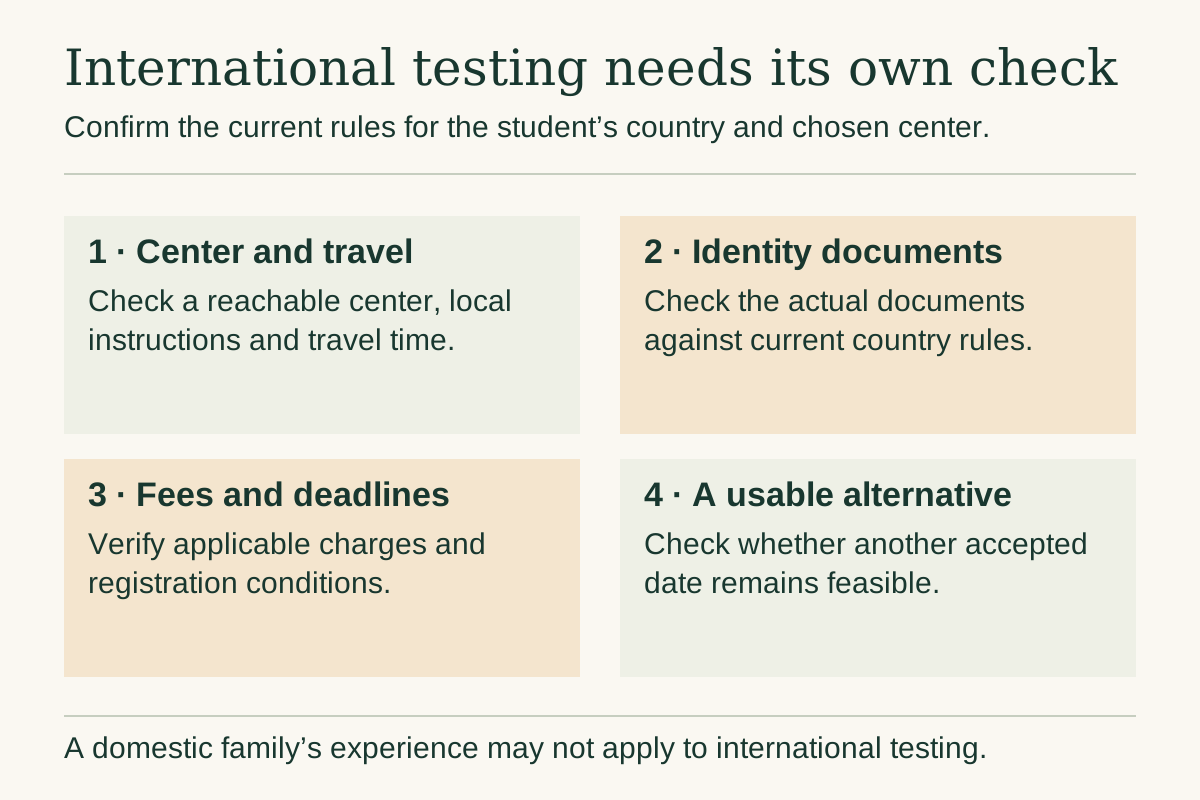
For a student outside the United States, check the current international registration rules, available test centers, identity requirements, and costs through College Board. Its international testing policies are the appropriate starting point. A domestic family's experience may not apply to the student's country or documents.
Travel can turn one test into a much larger undertaking. Check how the student will reach the center, whether an overnight stay is needed, and whether border or local travel requirements affect the plan. Keep refundable and nonrefundable costs distinct when comparing dates. Do not make a travel purchase before confirming the relevant registration and practical requirements.
Time zones matter for deadlines. Record the official time zone and convert carefully. Set a family target earlier than the last minute so a payment, connectivity, or document problem does not become a missed deadline. A reminder that says only “registration closes tonight” can be ambiguous across countries.
If the student is applying to institutions in several countries, create separate policy rows. A U.S. admissions convention does not establish another country's process. Even within one institution, applicant category or program rules can differ. Use current institutional guidance for the student's exact route.
The learning plan still matters. A long trip can affect rest and available review time, so include it when assessing readiness. The goal is a test date the student can reach and use sensibly, not simply a seat that happens to appear available.
Decide in advance what would make you postpone
A postponement rule helps separate a thoughtful change from a last-minute emotional reaction. Possible reasons include unresolved essential support arrangements, an illness, a newly discovered deadline conflict, or preparation evidence showing that the planned attempt has little value for its cost. The applicable change and cancellation rules still govern the practical options.
Write the rule before the final week. For example: “We will review the date if the required device arrangement is not confirmed by our planning checkpoint.” That rule is specific and observable. “We will postpone if she feels nervous” may be too broad, because ordinary nerves can accompany a well-prepared attempt.
For an academic readiness rule, identify the evidence you need rather than a perfect feeling. The student might need to complete a fresh practice test under comparable conditions and explain selected core skills. A target practice range can be one input, but do not pretend it guarantees the official result.
Postponement has costs too. It can reduce fallback options, affect application plans, and require further preparation. Compare those costs with the reason for changing. If the new date simply moves the same unresolved problem forward, add a concrete repair to the plan.
Review current registration information before changing a booking. Do not assume that deleting a calendar entry cancels registration, that a center change is free, or that one action automatically handles every associated arrangement.
Decide when testing is finished
Set a stopping rule alongside the first-test plan. Otherwise a family can continue testing because a higher score is always imaginable. A useful rule connects the decision to the purpose, the evidence, the remaining time, and what further preparation would displace.
One possible stopping point is that the available result already serves the specific requirement or opportunity you identified. Another is that the remaining eligible dates cannot meaningfully serve the intended deadline. A third is that the expected value of another attempt, under the student's circumstances, no longer justifies the cost and workload. These are judgment calls, not universal score cutoffs.
Discuss the student's view directly. A parent may see another test as a small commitment while the student experiences it as another month of reduced time for school or work. The student may also have a clear reason for wanting one more attempt. Neither perspective should be assumed without conversation.
Keep aspirations separate from promises. A student may want to pursue a higher score without treating that result as necessary for family approval. If you agree to another attempt, specify the preparation change and the final decision point so the finish line remains visible.
Our guide to choosing SAT prep can help assess whether additional support has a defined job. Buying another package should not quietly decide the retake question for you. Make the testing decision first, then choose the smallest support that fits it.
Build a calendar you can hand to another adult
A useful schedule survives a handoff. If another parent, guardian, or relative needs to manage transport, they should be able to find the test date, center, relevant arrival directions, device plan, and contact information without searching through a month of messages.
Keep private documents out of broadly shared calendars. A transport helper usually does not need the student's full score report or accommodation documentation. Share what the task requires, and keep sensitive records in the family's appropriate private location.
Distinguish status clearly. “Considering December” means something different from “registered for December.” “Accommodations requested” differs from “approved and confirmed for this administration.” “Score release scheduled” differs from “score received.” These labels prevent someone from reading a plan as proof that an action is complete.
Give every unresolved practical task an owner. The student can check a device step; a parent can confirm transport; the school can answer its own participation questions. Write the next action and a reasonable family checkpoint. You do not need elaborate automation to prevent two people from assuming the other one made the call.
After registration, run through our registration and test-day checklist. The calendar chooses when the attempt happens; the checklist helps make that attempt possible. Keep the two connected without turning either into a record of imaginary completion.
Test the plan against three ordinary disruptions
Before calling the timeline finished, ask what happens if the first attempt is interrupted by illness, the result is delayed, or the student's workload increases. You are not predicting those events. You are checking whether the plan contains a usable response without depending on perfect conditions.
For illness, identify the relevant official absence, change, or cancellation guidance and the next date that could still serve the purpose. Keep the medical decision separate from the desire to protect a registration fee. A paid appointment does not make the student well enough to test, and an unwell student should receive appropriate care.
For a delayed result, locate the institution's instructions and the official support route before the deadline approaches. The family may need to communicate through the institution's stated process. Do not assume that a delay automatically extends every deadline, or that an institution will treat a later result the way another institution does.
For a heavier school workload, decide which preparation tasks can shrink first. Preserve the work that addresses the current weakness and reduce unnecessary activity. A shorter, focused session may be more useful than completing a large assigned set while exhausted. If the conflict persists, review the date and purpose rather than asking the student to keep borrowing time from sleep.
Now ask another adult to read the one-page plan and describe what is confirmed. If they cannot tell whether the student is registered, which result deadline matters, or who is resolving a device question, clarify those fields. This small handoff check often exposes ambiguity that the person who built the calendar no longer notices.
Finally, write down which new facts would justify reopening the decision. A changed institutional policy, a support decision, or a substantial readiness change can matter. Another parent's preference usually does not. Keeping that distinction visible helps the family act on evidence while leaving ordinary comparison and worry outside the scheduling process.
Questions families ask about timing
Is the earliest possible test always the safest choice?
No. An early attempt can preserve future options, but it can also arrive before the student has learned relevant material or built a usable routine. Compare the value of earlier information with the cost of a premature attempt. If a practice test can answer the immediate readiness question, use it before assuming an official administration is necessary.
Should we register for several tests at once?
Do not make that the default. First identify what each test would accomplish and check the costs and applicable change rules. Sometimes a family may choose to preserve a particular option, but that choice should be explicit. Several bookings can create pressure to keep testing even when later evidence suggests stopping.
Is one bad practice test a reason to change the date?
Inspect the conditions and the errors. An interrupted or familiar test does not carry the same evidence as a fresh test taken independently under comparable conditions. Look for a pattern and ask whether the remaining preparation can address it. One number should prompt investigation, not automatically dictate a calendar change.
Can we count on a score arriving exactly when the table says?
Use the published release schedule for planning, with room for an individual delay and any required institutional processing. Do not promise a specific hour or treat a scheduled release as confirmation that a college has received the result. Check the requirements for the student's own submission route.
What if the school gives us a test date late?
Ask what is confirmed, which practical steps remain, and how the school's registration and device arrangements work. Then adapt the preparation plan to the actual time available. Avoid trying to compensate for a short notice period with an unrealistic daily workload. Focus on high-priority learning, familiarization, and a calm practical plan.
Make the decision with one page in front of you
Write the purpose of testing, the relevant institutional deadline, the proposed first administration, the scheduled result date, the preparation window, and one fallback. Add the support or device questions that could change the plan. Review that page with your child and agree on the next action. Register only after the date has a clear job and the practical requirements make sense.