
Start with one official practice test, a clear reason for testing, and a manageable agreement with your child. Those three things will tell you more than buying several prep subscriptions or collecting advice from other families. Your job is to create the conditions for useful practice and sound decisions. Your child needs to do the thinking, make the mistakes, and learn how to correct them.
The digital SAT can look unfamiliar if you took a paper test years ago. The screen, shorter passages, adaptive modules, and built-in tools have changed the experience. You do not need to master every testing detail before helping. You need an accurate map of the test, a way to interpret what your child finds difficult, and a process for deciding what happens next.
This guide explains that map and offers original family workflows and practice examples. Official requirements are linked to College Board; suggested routines are our editorial recommendations. Information was checked on October 25, 2026. College and scholarship policies must always be checked with the institution for the student's own application cycle.
Decide what the SAT is supposed to do for your family
Before discussing a target score, write one sentence about why your child might take the SAT. Possible reasons include satisfying a college's testing requirement, providing an additional academic result where scores are considered, or meeting a scholarship program's stated criteria. These are different purposes. Each can lead to a different preparation budget, deadline, and stopping point.
A family applying mainly to institutions that require a score has a practical scheduling problem first. A family whose institutions let applicants choose whether to submit scores has a different decision. A scholarship might set its own submission method, date, or score conditions. Do not assume that an admissions policy also describes merit aid, honors admission, a particular major, or an international applicant category.
Make a small table for the institutions your child is seriously considering. Include the exact testing policy, the application cycle, any separate scholarship rule, the last accepted test date if published, and the source link. Leave an unknown field marked as unknown until someone checks it. A friend's older sibling is not a current policy source.
The point is to establish a reason for the work. A student who knows that testing serves a particular opportunity can weigh it against school assignments, employment, sport, family duties, and rest. Without that reason, a target score can become a moving finish line. Someone always knows a student with a higher number.
You can revisit the purpose as the college list changes. Revisiting is sensible; changing it every time someone shares a score is exhausting. Put a review date on the calendar, then let your child practice without reopening the entire admissions conversation after every exercise.
Understand the test your child will actually take
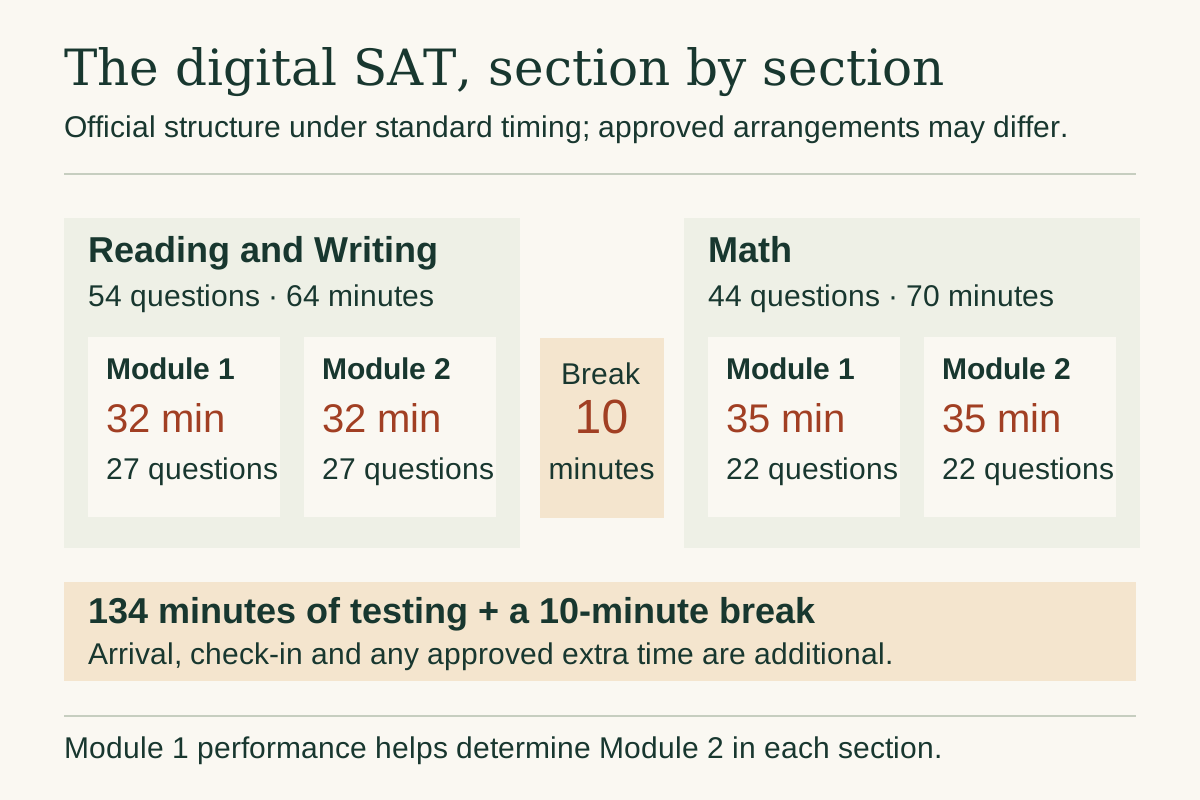
The SAT has Reading and Writing and Math sections. Under standard timing, Reading and Writing contains 54 questions in 64 minutes; Math contains 44 questions in 70 minutes. Each section has two modules. A ten-minute break separates the sections, so the 134 minutes of testing do not represent the entire time spent at a test center. College Board describes the current SAT structure.
| Part | Standard testing time | Questions | Useful parent takeaway |
|---|---|---|---|
| Reading and Writing | Two 32-minute modules | 54 total | Practice needs both accurate reading and grammar decisions. |
| Break | 10 minutes | None | Rehearse an ordinary break rather than studying through it. |
| Math | Two 35-minute modules | 44 total | Understanding the problem and using tools both matter. |
Approved accommodations can change the testing arrangements. Do not use a standard-timing table to override an approved plan. Similarly, the appointment includes check-in and instructions. Arrange transportation around the test center's directions and the student's arrangements, rather than calculating pickup from the testing minutes alone.
The test is administered through Bluebook. Becoming familiar with its tools is a practical task, like learning where the controls are before driving an unfamiliar car. It should happen before a scored baseline. If your child spends the first practice test searching for basic controls, the result mixes subject knowledge with avoidable interface confusion.
A useful first conversation is simple: “Show me how you move between questions and find something you flagged.” Let your child demonstrate. Avoid taking the device and doing it for them. Their ability to operate it independently is the behavior you want to establish.
What adaptive modules mean, and what they do not tell you
Each section begins with a module containing a range of difficulties. Performance in that module helps determine the second module. The score uses performance across both modules. College Board explains the process and its scoring approach in How Are Scores Calculated?.
The helpful family implication is modest: work carefully throughout the test and keep moving after a difficult question. Students do not benefit from trying to diagnose their route while the clock is running. An unusually challenging problem does not reveal a final score. An easier-looking question does not prove that something has gone wrong.
Avoid turning adaptation into a dramatic household story. “You must have gotten the hard module” is not a reliable substitute for the actual score report. Students differ in which material feels easy. A familiar grammar rule can feel simple to a strong reader while a particular vocabulary question feels impossible. Subjective difficulty is a weak measurement tool.
Also avoid online calculators that promise an exact digital SAT score from the number of wrong answers. The questions and scoring model matter; a raw total alone does not supply a universal conversion. A practice score produced by an official practice test has a different status from an estimate created by a third-party worksheet.
During review, ask questions your child can answer from evidence. Which problems took longer than expected? Where did they change an answer without a reason? Which directions did they misread? Those observations can change the next practice session. Speculating about an invisible route usually cannot.
One especially useful agreement is to postpone the post-test score prediction. After an official administration, talk first about transport, food, and whether anything needs reporting through official channels. Your child does not need to reconstruct the entire experience in the car. Wait for the report before making score-based decisions.
Translate Reading and Writing into skills you can recognize
College Board organizes Reading and Writing into Information and Ideas, Craft and Structure, Expression of Ideas, and Standard English Conventions. The section uses short texts or paired texts followed by a question. Its Reading and Writing overview explains these domains.
For family planning, translate the labels into actions. A student might need to identify what a passage actually claims, explain how a particular sentence functions, connect two statements logically, or recognize a sentence boundary. “Bad at English” hides those distinctions. A child can be an enthusiastic reader and still need explicit instruction in punctuation.
Reading practice should include explaining evidence. After answering a short question, your child can point to the words that support the answer. Then they can explain why an attractive wrong answer overstates, reverses, or wanders away from the passage. That explanation is more useful than saying an option “sounds right.”
Here is an original illustration, not an official SAT question. A short passage says: “The greenhouse plants watered every other day grew taller than those watered weekly. The experiment used one plant species and lasted four weeks.” A reasonable conclusion stays within the experiment. It does not claim that every species always grows taller with more frequent watering.
A parent can help by asking, “Which part of the passage supports the word every?” If there is no support, the answer needs reconsidering. You do not need specialist literary vocabulary to ask that question. You do need patience to let the student locate the evidence rather than supplying it.
For grammar, separate a rule from a preference. “I would phrase it differently” is not an explanation of a sentence-boundary error. If neither of you can state the rule, find a clear lesson or ask a teacher. Family arguments about how a sentence feels are a poor use of practice time.
Translate Math into decisions rather than labels
The Math section covers Algebra, Advanced Math, Problem-Solving and Data Analysis, and Geometry and Trigonometry. These categories are described in the SAT Math overview. A useful review identifies both the topic and the step that failed.
Consider an original example: a gym charges a $25 joining fee and $18 per month. After a certain number of months, a customer has paid $133. The model is 25 + 18m = 133, so 18m = 108 and m = 6. The arithmetic is short. The important decision is recognizing which cost occurs once and which repeats.
If your child writes 25m + 18 = 133, assigning more multiplication practice misses the problem. They need to translate the situation into an equation. Ask them to label each quantity before calculating. What does m mean? Which amount changes when another month passes? Why is the joining fee added once?
Now change the task. Suppose the question asks for the total after six months. The same relationship gives 25 + 18(6) = 133. A student who memorized one sequence of operations may struggle when the question changes direction. A student who understands the relationship can use it both ways.
This is the value of a fresh follow-up problem. Change the joining fee to $12, the monthly price to $16, and the total to $92. Then 12 + 16m = 92 gives m = 5. Ask for the equation before the answer. A correct answer obtained by guessing deserves a different next step from a correct answer supported by a clear model.
Avoid equating speed with understanding during the first explanation. If your child needs time to build the equation, give that time. Later, a short timed set can test whether the method has become usable under pressure. Teaching and measurement are different activities, and families often make both worse by combining them too early.
Use the calculator deliberately
A calculator is a tool for carrying out a plan. It does not decide which relationship a word problem describes, which units belong in the answer, or whether a displayed intersection answers the question. College Board's calculator policy is the authority for permitted use and approved devices.
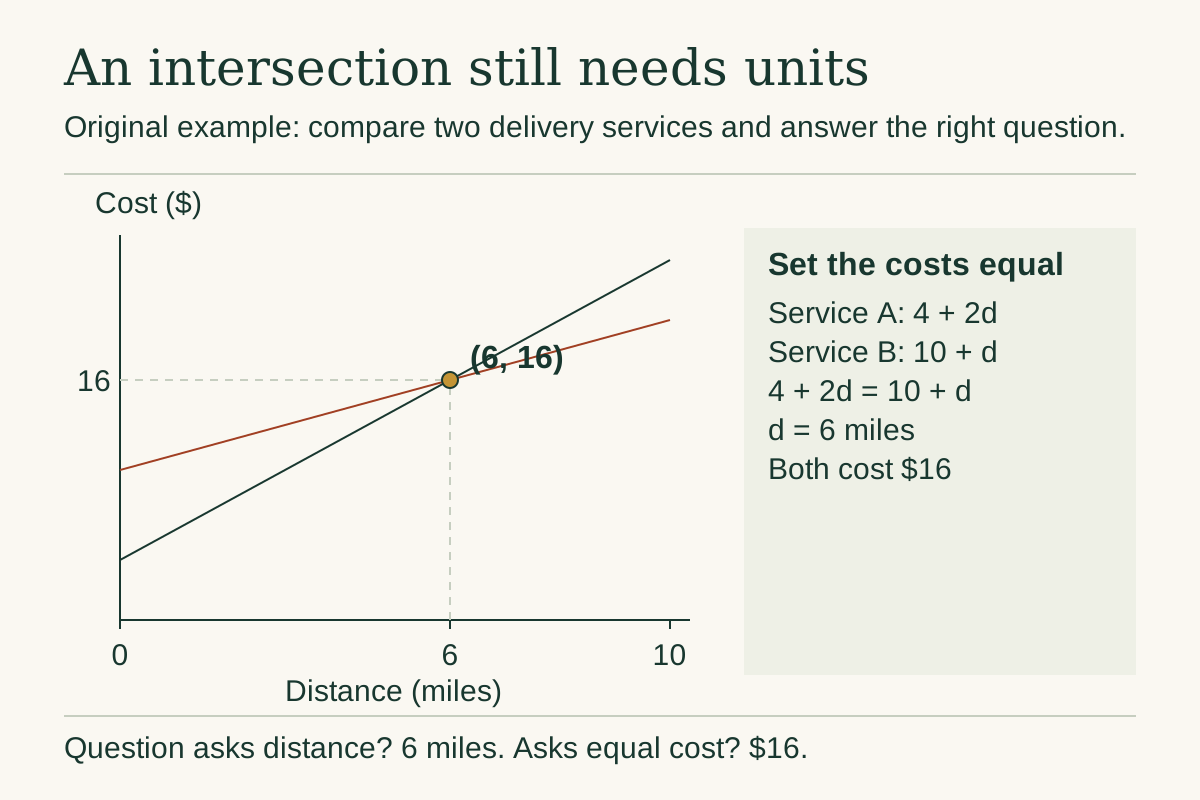
During practice, ask your child to explain what they entered and what the output represents. A graph can show where two expressions are equal, but the student still needs to know which coordinate matters. If the question asks for time, copying the vertical coordinate instead of the horizontal one can turn correct tool use into an incorrect response.
Here is a small original example. A delivery service charges 4 + 2d dollars for d miles, while another charges 10 + d dollars. Entering both expressions can show their intersection. Algebra gives 4 + 2d = 10 + d, so d = 6. At six miles, both cost $16. The answer could be six miles or sixteen dollars, depending on the wording.
Ask your child to finish with a sentence. “The services cost the same at six miles.” That sentence checks meaning and units. It is a simple habit, and it exposes errors that a screen full of correct calculations can conceal.
Students should explore the tools in the actual testing environment. Familiarity with another graphing app does not automatically mean familiarity with Bluebook's version. Equally, a child does not need to use a graph for every algebra question. Compare methods on a few representative problems and choose a reliable one for each situation.
Do not add a complicated calculator strategy in the final days because someone online called it essential. New methods need practice and checking. If a method repeatedly produces uncertain entries or unexplained outputs, return to a simpler approach while the student develops the missing skill.
Begin with the preview, then take a clean baseline
Bluebook provides an untimed test preview and full-length practice tests. The preview introduces the experience without producing a score. Scored practice tests are available when the student signs in through a College Board student account. College Board explains these distinctions in Practice on Bluebook.
Use the preview to remove basic friction. Your child should locate navigation, review controls, the timer, reference material, and the calculator where available. They should try any relevant assistive technology and consult current official directions. Write down technical questions while there is time to resolve them.
Then arrange one baseline in conditions close enough to the intended test to be useful. Choose a time when the student is reasonably rested. Use the intended device if possible. Keep interruptions away. Follow the practice directions, use the applicable timing, and record any departure from the plan.
The record does not need to be elaborate. “Started at 9:05; doorbell interrupted Math; paused for five minutes” is enough to qualify the result. Without that note, you might later interpret a disrupted score as a clean measure. If someone explains questions during the test, mark it as supported work rather than an independent baseline.
Do not repeat a familiar test and treat the increase as equivalent evidence of new performance. Remembered questions can help practice a method, but they change what the score means. Save unused material for later checks. Maintain a simple list of practice tests already completed so your child does not accidentally reuse one as a fresh assessment.
Your response to the baseline matters. Thank your child for completing a difficult diagnostic task. Ask what surprised them. Set the score aside long enough to inspect the pattern of errors. A baseline is useful because it reveals work to do, not because it settles what the student can eventually achieve.

Read the first report without turning it into a verdict
SAT total scores range from 400 to 1600, with Reading and Writing and Math each ranging from 200 to 800. College Board outlines these scales in its SAT Suite style sheet. The number belongs in a decision process; it should not become a description of the child.
Start with the two section scores and the skills shown in the report. Two students with the same total can need very different preparation. One might need algebra foundations while another needs careful reading under time pressure. Purchasing the same course for both because they share a total is an avoidable mismatch.
Inspect a small sample of questions before making a plan. Choose a few wrong answers, a few uncertain correct answers, and anything the student left unanswered. Ask for the student's original reasoning where they can remember it. An answer explanation tells you how the problem can be solved; it does not automatically tell you why your child missed it.
A percentile also needs context. It describes a comparison group, not a probability of admission. Do not transform a percentile into an admission chance or a promise about college readiness in every subject. If a school publishes score ranges, check which students and application year those ranges describe before using them as context.
For a fuller decision process, use our guide to understanding SAT scores and retakes. At this stage, the productive question is narrower: which two or three teachable weaknesses would make the next week of practice more useful?
Build an error log your child will actually use
A long spreadsheet can become another chore. Begin with four fields: problem source, what went wrong, the corrected reasoning, and a date to try a fresh problem. Let the student write short notes in their own words. The purpose is to improve future decisions, not to produce attractive documentation for a parent.
Useful categories include a missing concept, an incorrect setup, a misread condition, a calculation or transcription error, an unsupported inference, and a timing problem. These categories are working hypotheses. A student who says “careless” may later discover that they never understood why a sign changed. Keep the diagnosis open until a fresh example tests it.
For the gym problem above, an error note might read: “I multiplied the joining fee by months. The joining fee is paid once; monthly cost repeats. Label quantities before writing the equation.” The follow-up is a new fixed-plus-variable cost problem, not merely copying the original solution three times.
For the greenhouse passage, the note could read: “I chose an answer about all plants. The evidence only covered one species over four weeks. Match the scope of the answer to the scope of the evidence.” A later passage with a different experiment can test whether the distinction transfers.
Add correct answers that involved guessing. Otherwise the log hides weaknesses until test day. Conversely, do not require an essay for every simple slip. If the student accidentally entered 16 instead of 61, a brief note and a useful checking routine may be enough.
Review a few entries once a week. If the same category keeps returning, adjust instruction. If the child can explain the correction but cannot apply it to fresh material, schedule another teaching session. If they apply it accurately untimed but struggle under the clock, change the practice conditions. The log earns its place only when it changes what happens next.
Agree on a family role that supports independence
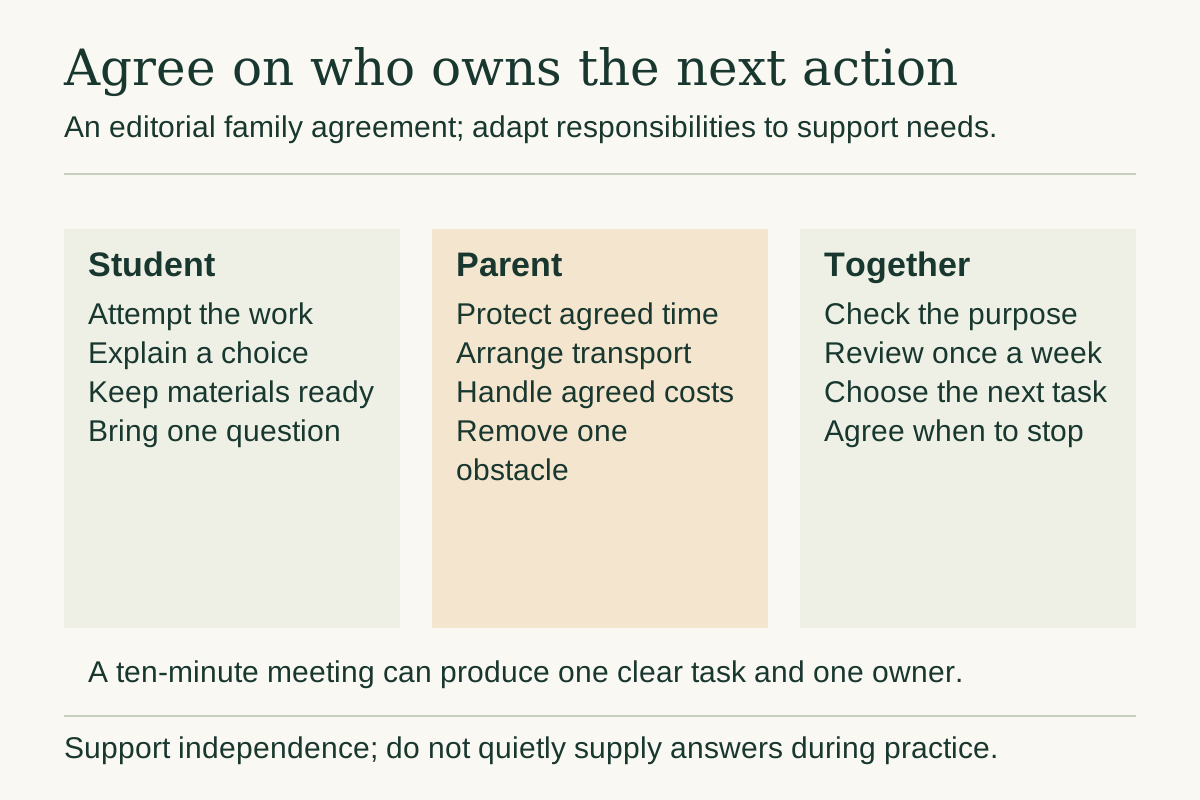
Parents can manage transport, payment, a quiet space, and the shared calendar. Students should increasingly manage their materials, practice attempts, questions, and review. The division will vary with age and support needs, but it should be explicit. Unspoken expectations are a common source of avoidable friction.
Try a ten-minute meeting once a week. Ask what was completed, what became clearer, what remains difficult, and what help would remove the next obstacle. Keep school performance and wellbeing in the conversation. End with a small plan the student can describe back to you.
This is a suggested household routine, not a proven treatment or a guaranteed score strategy. Its value is practical: it keeps the conversation predictable. Constant reminders can make every meal feel like a progress review. A scheduled check-in gives both of you a place to raise concerns without turning the test into the background topic of family life.
Choose reminders together. A student might prefer a calendar alert, a note after dinner, or a verbal reminder fifteen minutes before practice. Ask before building a complicated tracking system. If a simple calendar works, keep it. If it fails, identify why before adding another app.
Be careful with incentives. Rewarding only the final score attaches the reward partly to factors outside the student's immediate control. If you choose an incentive, connect it to an agreed behavior such as completing independent attempts and reviewing mistakes honestly. Avoid making honesty expensive by punishing a disappointing practice result.
You can say, “I need to know whether this plan fits your week.” That invites useful information. “You clearly aren't trying” closes the conversation before you know whether the issue is fatigue, confusion, fear, or an unrealistic workload.
Plan a first week that produces useful information
A first week should answer practical questions, not cover the entire curriculum. The following sequence is an editorial template. Move the days around family obligations and give technical or accommodation questions the time they require.
| Session | Main job | Evidence to keep |
|---|---|---|
| Opening conversation | Identify why testing matters and what deadlines need checking | One written purpose and a short list of unknowns |
| Device session | Try the Bluebook preview and resolve basic access problems | Questions about tools or device readiness |
| Baseline session | Complete fresh official practice under recorded conditions | Test identifier, score, interruptions, student impressions |
| Review session | Inspect selected errors and uncertain answers | Two priority skills and a few error-log entries |
| Teaching session | Work on one priority with explanation and fresh questions | What the student can now do independently |
| Family check-in | Decide the next week's time and support | A small schedule and one specific parent task |
Do not squeeze every row into consecutive evenings. A full practice test takes a substantial block, and review deserves another block. If the week is crowded, spread the opening cycle across two weeks. The important outcome is trustworthy information and a sustainable next step.
After the teaching session, ask for a brief demonstration rather than a report of hours. Your child might solve one new equation, identify the evidence for a reading answer, or explain when a semicolon can join two clauses. A demonstration can reveal whether the explanation became usable knowledge.
Our SAT study plan for parents develops this cycle into a longer routine. Keep the first week small enough that you can actually observe it. An ambitious twelve-week calendar built before the baseline often needs rebuilding immediately.
Choose resources after you identify the missing support
Begin by exploring official practice and current free instruction linked by College Board. College Board's practice hub is a useful starting point. A family should know what is available before assuming that effective preparation requires a large purchase.
Paid support can be reasonable when it solves a defined problem. A tutor might help a student who repeatedly misunderstands algebra explanations. A structured class might help someone who benefits from a fixed appointment. An independent learner may need only targeted materials and occasional feedback. These are selection hypotheses, not promises that one format produces a particular gain.
Write the problem before comparing products. “Needs someone to explain why evidence supports an answer” is a better purchasing brief than “needs a higher score.” Ask a provider to show how a typical session addresses that problem. Look for an independent attempt, a clear explanation, a fresh check, and a plan for later review.
Ask what happens when the student remains confused. A provider who simply repeats the same explanation may be a poor fit. Ask how progress is judged, which practice materials are used, what the cancellation terms are, and whether extra work is required outside sessions. Read recurring billing terms before paying.
Do not mistake a polished dashboard for evidence that your child learned. Time logged, questions answered, and lesson completion can help describe participation. They do not establish transfer to unfamiliar problems. Fresh independent work is a more direct check of the skill you are trying to build.
For a detailed comparison framework, read choosing SAT prep. Buy the smallest amount of support that has a clear job, then review whether it is doing that job before expanding the commitment.
Adapt the process for different starting points
A student whose school has not yet covered an important math topic may need instruction before timed practice is meaningful. Ask what they have studied and compare it with the errors. Do not interpret an unfamiliar topic as a failure of effort. Equally, a familiar course title does not prove that the underlying skill is secure.
A student who reads accurately but slowly may need help choosing a first step, reducing unnecessary rereading, or recognizing question types. Start by observing a few problems without the clock. If comprehension is weak even with time, speed practice alone is unlikely to address the underlying issue.
A multilingual student may understand a scientific idea but struggle with a particular English construction. Separate subject understanding from language interpretation. Ask them to explain the idea in ordinary words, then work on the wording that caused trouble. Avoid making assumptions about support eligibility; consult the rules for the student's test and setting.
A student with a disability or established support needs should discuss accommodations early with the appropriate school professional and College Board. The accommodations deadlines page explains that review can take up to seven weeks and may take longer when additional documentation is needed. A school plan should not be treated as automatic confirmation of test arrangements.
A student who works evenings or cares for a sibling needs a schedule built around those responsibilities. Three brief, focused sessions may be more realistic than an elaborate daily plan. Do not compare their available hours with a classmate's hours without accounting for the difference in obligations.
A student already near a useful stopping point may need selective review rather than a larger course. Ask what another month of preparation would displace. The family is choosing how to use finite time, and the SAT is one claim on that time.
Recognize when the plan needs changing
Missed sessions are information. One missed session may be an ordinary interruption. A repeated pattern deserves a conversation about the plan. Was the task too vague? Was the student unable to start without help? Did homework take longer than expected? Did the available room stay noisy? Each explanation suggests a different repair.
Change one meaningful element at a time when possible. Move the practice slot, reduce the task, choose clearer instruction, or arrange support for a particular skill. If everything changes together, it becomes difficult to know what helped. You do not need a formal experiment; you need enough clarity to avoid repeating a failed arrangement.
Watch for a mismatch between practice behavior and the measure you use. If a student can recite an explanation but misses every new version, more explanation-watching may be the wrong response. If they can solve fresh questions but run out of time, another untimed lesson may be less useful than a small timed set followed by review.
If preparation is consistently interfering with sleep, schoolwork, or ordinary functioning, reduce the burden and speak with an appropriate school or health professional when needed. Do not respond to serious distress by adding more tests. The family can revisit the test date, the purpose of testing, and the amount of preparation.
For timing choices, our guide to when your child should take the SAT explains how to work backward from actual deadlines. A date should serve the student's circumstances. The schedule does not become correct merely because you wrote it neatly.
Keep a small information folder and a clear handoff
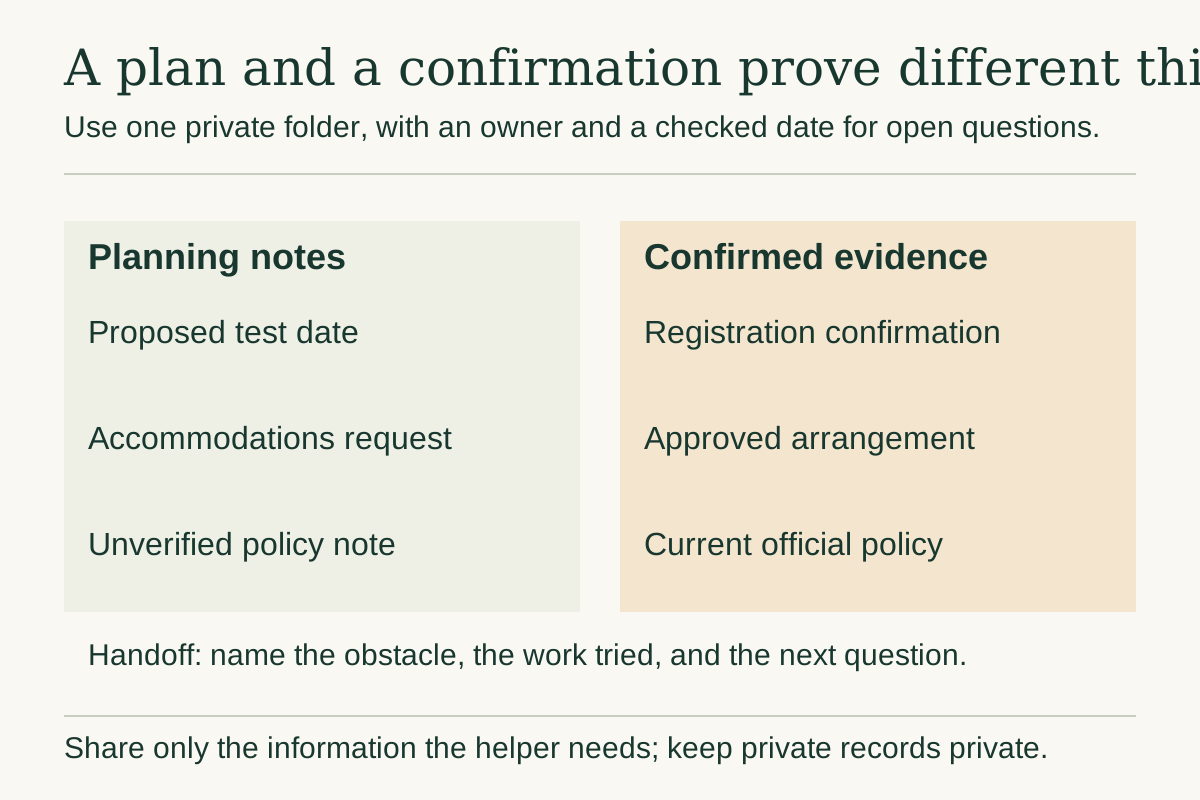
Create one place for practical records. It can be a paper folder or a private document the family already uses. Keep the test purpose, relevant policy links, registration confirmation, device questions, approved arrangements, and the practice-test list together. Avoid building a second system that needs its own maintenance. The folder should make the next action easy to find.
Separate official documents from planning notes. A registration confirmation establishes something different from a calendar entry saying “SAT.” A request for accommodations establishes something different from an approval letter. A screenshot of an admissions page may become outdated. Label each item with what it proves and when it was checked so the family does not accidentally turn an intention into a completed task.
Decide who owns each open question. A parent might confirm transport while the student checks the practice schedule with a teacher. If you both assume the other person handled a task, the folder can look complete while the task remains undone. A short line such as “Device question: parent checking with school by Thursday” prevents that ambiguity without requiring a project-management app.
Protect the student's information. A score report, disability documentation, account details, and identity documents do not belong in a public group chat. Before uploading material to a prep service, read what information it requests and why. Use the minimum needed for the task. A tutor can often discuss a learning problem without receiving an entire admissions file.
When another adult helps, give them a focused handoff. Instead of sending every practice result, explain the specific difficulty, the work already attempted, and the question you need answered. For example: “She can solve linear equations when they are written out, but reverses fixed and monthly costs in word problems. Can you watch her model two fresh examples?” That request gives a teacher something observable to address.
After the conversation, record the next action in ordinary language. “Practice labeling quantities before calculating” is more useful than “improve quantitative reasoning.” Ask the student to explain the action, because the adult's understanding does not establish that the student knows what to do. Keep any supporting example beside the note if it will help them start independently.
Use a worked review conversation to keep the focus on learning
Imagine a hypothetical student, Lena, who chose the correct answer to the delivery-service problem but cannot explain whether six represents miles or dollars. Her parent could congratulate the correct choice and move on. A more useful response is to ask her to put units beside both coordinates of the intersection. That small request reveals whether the answer came from understanding or recognition.
Suppose Lena now says that the services cost six dollars. Rather than supplying the answer immediately, the parent asks her to substitute six miles into each price expression. Both give sixteen dollars. Lena can now correct the sentence herself: the services have the same price after six miles, and that price is sixteen dollars. The parent records a meaning-and-units issue, rather than labeling the whole topic as weak algebra.
A few days later, Lena compares two different pricing expressions and explains both coordinates correctly without help. That is evidence about a specific skill on fresh material. It does not prove a future SAT score, and it does not establish that the parent caused every change in performance. It does justify moving on from that narrow issue while checking it again in mixed practice.
This example shows the kind of evidence worth discussing at a family check-in. The claim is concrete: the student can now interpret an intersection in a new cost problem. Keep progress descriptions at that level whenever possible. They are easier to verify, easier to act on, and less likely to turn one good or bad evening into a sweeping judgment about ability.
Questions parents commonly ask
Do I need to teach the material myself?
No. You can be useful by arranging time, checking official requirements, and asking your child to explain what they learned. If your explanations create confusion or arguments, use a teacher, a clear lesson, or suitable tutoring. A parent who remembers algebra well can still be a poor teaching match for their own child. Recognizing that is a practical decision, not a failure.
Should my child practice every day?
There is no universal daily schedule in this guide. Choose a routine the student can sustain and evaluate by the quality of independent work and review. Short sessions can work well for a specific skill; a full practice test requires a different block. Protect time for reviewing mistakes. Filling every day with questions while skipping review can produce a large activity total with little understanding of what needs to change.
What score should we aim for?
Start with the purpose of testing, current practice evidence, and the published policies of relevant institutions. Separate an aspiration from a requirement. If a scholarship states a condition, record its exact terms. If a college publishes a score range, understand the population it describes. Avoid treating a number chosen by another family as your child's obligation.
How quickly should we expect improvement?
We cannot promise a rate. Starting knowledge, available time, the fit of instruction, practice conditions, and the particular weaknesses all matter. Look first for evidence that the student can solve fresh examples of a skill they previously missed. Later, use a fresh official practice test under comparable conditions to assess the broader picture. A short-term score movement alone cannot explain its cause.
Should we keep discussing college during practice?
Keep most practice focused on the problem in front of the student. College planning deserves its own time. A reminder about admissions stakes is unlikely to help a child decide whether a sentence needs a comma or solve a system of equations. Discuss purpose when setting the plan, then give the student room to learn without attaching every mistake to their future.
Your next useful step
Set aside a short conversation with your child. Write the reason for testing, identify the official policy questions that still need checking, and agree on a time to explore Bluebook. Then schedule one clean baseline and one separate review. Those appointments will give your family a much firmer starting point than another evening of collecting conflicting advice.